
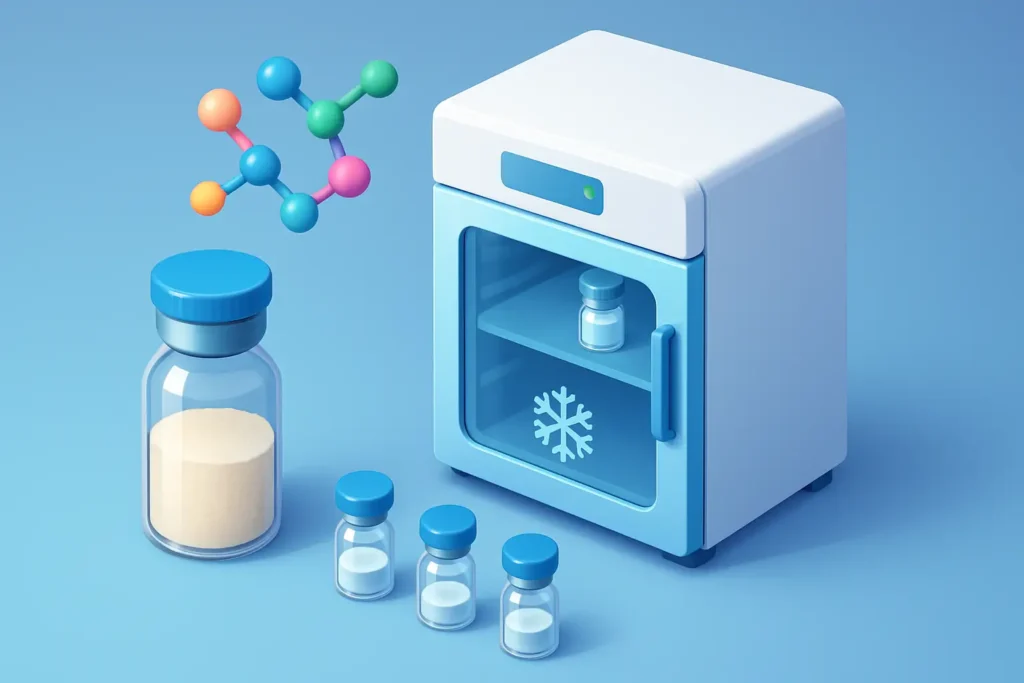
A lyophilised peptide can arrive looking almost unchanged after transit – a neat, dry cake or powder – and still be one handling error away from avoidable degradation. In practice, the failure mode is rarely dramatic. It is usually a slow loss of signal, unexpected variability between repeats, or a stubborn shift in chromatograms that sends you back through your method, reagents, and instrument logs.
If your work relies on consistent identity and purity, storage is not an afterthought. It is part of chain-of-custody. The goal is simple: keep the peptide dry, cold (as appropriate), and protected from repeated thermal cycling and contamination, with documentation that stands up to internal review.
What “lyophilised” does – and does not – protect against
Lyophilisation (freeze-drying) removes water to improve stability versus aqueous solutions. That helps because many degradation pathways accelerate in the presence of moisture: hydrolysis, deamidation, oxidation and aggregation can all become more likely when a peptide is stored in less controlled conditions.
However, lyophilised does not mean invulnerable. The powder can still absorb atmospheric moisture during brief exposure at the bench. Some sequences are particularly sensitive to oxidation (for example, methionine- or cysteine-containing peptides), while others can tolerate short exposures but suffer when repeatedly warmed and cooled. Your storage plan should assume the peptide will behave like a high-value analytical standard: stable when protected, unreliable when handled casually.
How to store lyophilised peptides: set the baseline conditions
For most research peptides, the baseline expectation is cold, dry, dark, and sealed. In a controlled laboratory setting, that typically translates into long-term storage in a freezer with appropriate packaging and minimal door-open time.
A practical rule is to use colder storage for longer horizons and higher sensitivity studies. Many laboratories hold lyophilised peptides at -20°C for routine medium-term use and reserve -80°C for extended storage or sequences known to be less stable. Refrigerated storage (2-8°C) may be acceptable for short periods if the material remains sealed and desiccated, but it is not where you want to park inventory for months.
Light is rarely the primary driver for lyophilised peptide degradation, but it is easy to control. Store vials in their secondary packaging or an opaque container where possible, particularly if your workflow involves frequent retrieval.
Moisture is the quiet threat: humidity control and sealing
Humidity exposure is the most common avoidable risk. The vial may only be open for seconds, but that is enough for moisture to condense on cold glass or for hygroscopic material to take on water.
Keep lyophilised peptides in tightly closed, intact vials. If you are transferring material into other containers, use low-binding, laboratory-grade tubes with reliable seals. Include desiccant where appropriate in secondary containment, and replace it on a sensible schedule rather than trusting a sachet that has lived in a drawer for a year.
The other half of humidity control is behavioural: avoid opening a vial straight from a freezer into warm, humid lab air. If the vial is below dew point, condensation can form rapidly. Where your SOP allows, let sealed vials equilibrate to room temperature before opening. That single step reduces the risk of moisture ingress and makes weighing or reconstitution more consistent.
Minimise freeze-thaw cycling by design
Lyophilised peptides tolerate cold storage well, but repeated temperature cycling is a known source of variability, especially when it leads to micro-condensation events or repeated exposure to ambient conditions.
If the peptide will be used more than once, plan aliquots. Aliquoting means you only thaw and open what you will use in a defined window, keeping the remainder untouched. This is particularly important if your work involves quantitative comparisons across days or weeks, where small changes in concentration or integrity can distort outcomes.
Aliquots should be sized to your typical experiment rather than your ideal one. A 10 mg vial split into ten 1 mg units is often more useful than two 5 mg units that still force repeated openings.
Reconstitution decisions that affect stability
Many peptides are reconstituted prior to use, and this is where stability often falls off a cliff. Aqueous solutions invite hydrolysis and microbial risk; certain solvents can introduce their own issues.
The correct solvent depends on sequence properties and your downstream method, so it is not responsible to prescribe a single universal approach. What you can control is process: use sterile technique where relevant, use appropriate-grade solvents, and document the solvent, concentration, and date of reconstitution directly on the aliquot.
If your protocol requires bacteriostatic water, treat it as a controlled reagent with its own storage and expiry discipline. If you are working with buffers, check compatibility with your analytical method and be cautious about prolonged storage in buffered aqueous systems unless you have stability data.
Once reconstituted, store solutions at colder temperatures and for shorter durations than the dry form. If your work requires repeated use over time, freeze aliquots of the solution rather than repeatedly accessing a single tube.
Labelling and documentation: make storage auditable
Storage failures are often discovered when someone cannot answer basic questions: Which lot was used? How long was it open? Was it reconstituted once or twice? What concentration was assumed?
Your label should make the vial usable without hunting through emails. At minimum, include compound identifier, quantity or concentration, solvent (if applicable), date received, date reconstituted, and an internal reference to the certificate of analysis or lot number. If you maintain a digital inventory, the physical label should still stand on its own for day-to-day bench work.
For controlled research environments, align this with your chain-of-custody expectations: who received it, where it was stored, and any deviations. That level of discipline is not bureaucracy. It is what protects reproducibility.
Handling at the bench: small choices that prevent big variance
When a peptide is removed from storage, your objective is to keep exposure brief and controlled.
Work on a clean surface. Use dedicated tools where practical, especially for weighing. Avoid touching vial rims or caps with gloves that have handled other reagents. If you are weighing, minimise the time the vial remains open and avoid breathing directly over the container. These are mundane details, but they are the difference between a vial that remains a reliable reference and one that slowly picks up contaminants.
If you see clumping after repeated access, treat it as a signal. It may indicate moisture uptake. That does not automatically mean the peptide is unusable, but it is a cue to tighten handling and consider switching to aliquots.
Shipping and receipt: preserve the cold chain you can control
Even when your supplier ships quickly and discreetly, you still need a receiving routine. Delays at goods-in and weekend deliveries are common sources of unplanned warming.
Arrange for prompt receipt and immediate placement into appropriate storage. Record the condition on arrival if that is part of your quality system. If your internal process includes quarantine before release, ensure quarantine storage matches the peptide’s needs rather than leaving material at ambient conditions.
If you are ordering for time-sensitive experimental schedules, it is sensible to align purchasing with delivery capacity so the material does not sit in a depot or reception area. Reliability is not only about the product – it is also about the workflow around it.
When “it depends” is the correct answer
Two labs can store the same lyophilised peptide differently and both be reasonable, because the right choice depends on risk tolerance and use-case.
If a peptide is being used as a qualitative tool in early method development, you may accept a practical approach: -20°C, sealed, aliquoted if convenient, and replaced regularly. If the peptide is a reference material for quantitative work, or supports repeated analytical comparisons, you tighten everything: colder storage, stricter aliquoting, documented handling, and shorter open times.
Sequence matters too. Peptides prone to oxidation may merit inert gas backfilling and stricter light control where feasible. If you do not have sequence-specific stability data, default to conservative handling and avoid introducing unnecessary variables.
Quality signals that support good storage practice
Good storage starts with good material, because you cannot store your way out of identity uncertainty.
A supplier providing independent third-party analytical testing and clear certificates of analysis makes your documentation easier and your internal verification stronger. If you are sourcing peptides for controlled research use, look for consistent packaging standards, traceable lots, and evidence of purity and identity verification. For UK-based buyers who value fast, tracked fulfilment and documentation-friendly ordering, Precision Peptides provides third-party testing and certificates of analysis as part of a quality-first supply model at https://Www.precision-peptides.shop.
Practical storage defaults you can defend in a protocol
If you need a defensible starting point for an SOP on how to store lyophilised peptides, it looks like this: keep vials sealed and desiccated, store long-term at -20°C or colder, avoid opening cold vials into humid air, aliquot to prevent repeated access, and label everything so another trained person could reproduce your handling without guessing.
That is not overkill. It is the simplest way to protect the value of your analytical work and reduce the kind of low-grade variability that wastes the most time.
A helpful closing thought: treat every vial as if you will need to justify its history later, because the day an experiment behaves unexpectedly is the day storage discipline turns from “nice to have” into your fastest path back to confidence.