
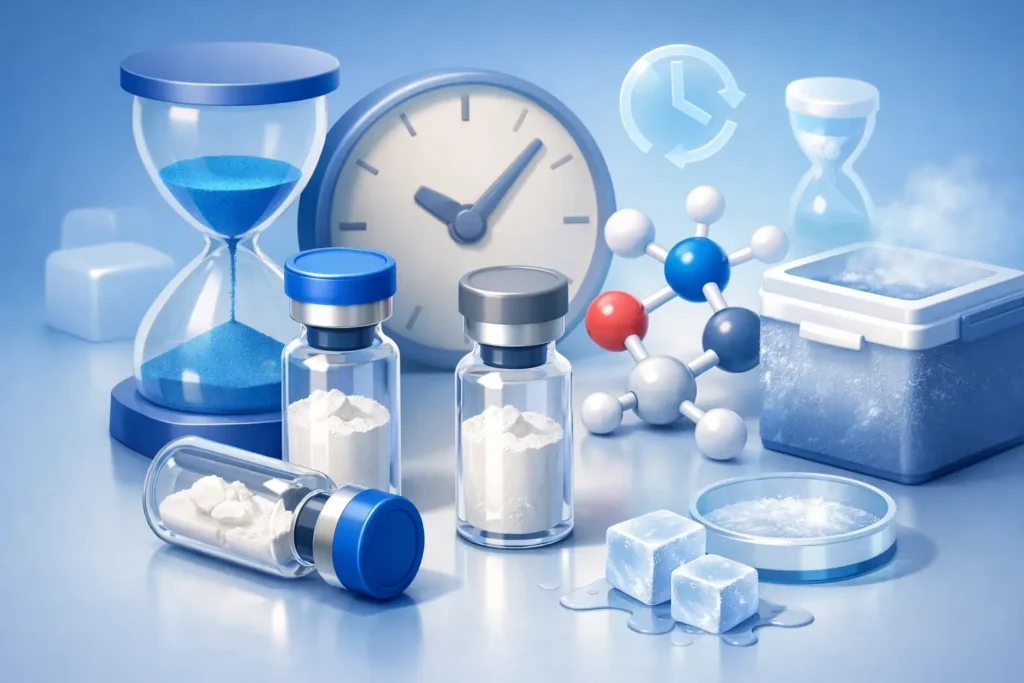
A peptide that arrives clean, sealed and supported by documentation can still become a poor research material if it is stored badly. For laboratories and research buyers, shelf life is not a minor detail. It directly affects stability, reproducibility and confidence in downstream analytical work.
When people ask how long do lyophilised peptides last, the honest answer is that there is no single expiry rule that fits every compound. Lyophilised peptides are generally more stable than reconstituted peptides, but actual longevity depends on sequence, purity, packaging, storage temperature, moisture exposure, light exposure and handling discipline. In controlled conditions, many lyophilised peptides remain viable for research use for months and often longer, but that estimate only holds if the product has been manufactured, packaged and stored to a verified standard.
How long do lyophilised peptides last in practice?
In practical research settings, lyophilised peptides commonly last significantly longer than their reconstituted counterparts because freeze-drying removes water, which is one of the main drivers of degradation. A sealed vial stored correctly at low temperature will usually maintain stability far better than the same material once mixed.
That said, “last” can mean different things. It may refer to visual integrity, retained purity, preserved identity or acceptable performance in a specific assay. A peptide may still appear unchanged while having already lost some analytical reliability. For serious research work, shelf life should be considered in terms of verified stability, not just whether the powder still looks intact.
As a general working principle, a lyophilised peptide stored unopened in a freezer under dry, dark, controlled conditions will typically last longer than one kept in a cupboard, repeatedly handled, or exposed to condensation. Short-term refrigeration may be acceptable for some compounds, but room-temperature storage is usually the weakest option unless explicitly justified by the product’s stability profile.
Why lyophilised form is more stable
Lyophilisation improves stability by removing the water that can accelerate hydrolysis and other degradation pathways. In dry form, the peptide is less chemically active than it would be in solution. That is why lyophilised material is generally preferred for storage and shipping in research supply chains.
Even so, dry does not mean indestructible. Peptides can still degrade through oxidation, contamination, temperature fluctuation or repeated exposure to ambient air. Some sequences are inherently more delicate than others. A hygroscopic peptide, for example, may pull in moisture rapidly once opened, which can shorten its useful storage life even if it was initially well prepared.
This is where supplier controls matter. Independent third-party analytical testing, verified purity and identity, and certificates of analysis are not just marketing points. They establish the starting condition of the material. Without that baseline, it becomes much harder to judge whether a later performance issue came from storage failure or poor-quality material from the outset.
The main factors that affect peptide shelf life
Temperature is the biggest practical variable. Lower temperatures generally slow degradation, which is why freezer storage is widely preferred for lyophilised peptides intended for ongoing research inventory. Refrigeration may be acceptable for shorter periods, but repeated warming and cooling cycles can create problems, especially if condensation forms in or around the vial.
Moisture is another major risk. Once water enters the environment, the peptide is no longer benefiting from the same protection provided by lyophilisation. Exposure can happen through loose seals, frequent opening, poor vial handling or moving cold vials into humid air before allowing them to equilibrate properly.
Light and oxygen also matter. Some peptide sequences are more vulnerable to oxidation or photodegradation than others. Amber packaging, minimal headspace disturbance and controlled storage conditions can help reduce that risk.
Handling discipline is often underestimated. A peptide may be stored at the correct temperature but still compromised by repeated access, inconsistent labelling, poor stock rotation or opening the vial unnecessarily. For laboratories running repeat analytical work, those small handling errors accumulate into larger variability.
Unopened vs opened lyophilised peptides
An unopened vial in intact packaging is always in the stronger position. Once the seal is broken, environmental exposure begins, even if only briefly. The product may still remain suitable for research use for a meaningful period, but the margin for error narrows.
For opened vials, it is sensible to minimise access events, use clean controlled procedures and return the material to appropriate storage without delay. If the peptide will be used over multiple timepoints, aliquoting strategy should be considered at the planning stage rather than improvising once the vial is already in circulation.
This is especially relevant for buyers managing multiple compounds at once. It is not enough to know the nominal shelf life. You also need to know how often the vial will be handled, who will handle it and whether your storage process is actually consistent day to day.
How reconstitution changes the timeline
Once a peptide is reconstituted, the storage clock usually shortens considerably. In solution, the material becomes more susceptible to hydrolysis, microbial contamination and general instability. The exact timeline depends on the solvent, concentration, peptide sequence and storage conditions, but reconstituted peptides almost never match the longevity of lyophilised stock.
That is why many researchers keep material lyophilised until there is a clear need to prepare it for a defined analytical purpose. If repeated use is expected, smaller aliquots can reduce the number of freeze-thaw cycles and limit avoidable degradation.
For compliance-forward research settings, storage instructions should always remain aligned with the product specification and documentation supplied for that material. Research compounds are for laboratory, analytical and experimental use only, not for human or animal consumption.
What good storage looks like
Good storage is less about guesswork and more about control. A peptide should be kept sealed, dry, protected from light and stored at a stable low temperature appropriate to its specification. It should be clearly labelled, dated and separated from unnecessary handling traffic.
It is also good practice to avoid moving a cold vial straight into a humid environment and opening it immediately. Allowing the vial to reach temperature in a controlled way before opening can reduce condensation risk. That single step can make a meaningful difference, particularly with moisture-sensitive materials.
Documentation matters here as well. If your lab records receipt date, storage conditions, opening date and usage history, it becomes much easier to defend data quality later. A certificate of analysis confirms what was supplied. Internal handling records help show what happened afterwards.
Why supplier quality affects storage confidence
Shelf life begins before the vial reaches your bench. If a peptide was exposed to poor handling, weak packaging or uncontrolled transit conditions before delivery, its theoretical storage potential may already be reduced.
For that reason, serious buyers usually assess more than product name and price. They look for controlled packaging and handling standards, independent third-party analytical testing, purity and identity verification, and clear documentation. Fast, tracked and discreet shipping also matters because unnecessary transit delays can introduce avoidable risk.
A supplier such as Precision Peptides positions around exactly those controls: verified purity, documented identity and operational reliability designed to support controlled research use. For buyers comparing vendors, that level of rigour is directly relevant to shelf-life confidence because it strengthens the chain of custody from dispatch to storage.
Common mistakes that shorten peptide lifespan
The most common mistake is assuming all peptides behave the same way. They do not. Sequence-dependent stability is real, and a storage approach that works for one compound may be unsuitable for another.
Another frequent problem is repeated opening of a master vial instead of planning smaller-use portions. Add inconsistent freezer temperatures, missing labels or casual bench exposure, and shelf life can shorten quickly. In some cases, degradation is gradual enough that researchers only notice it after assay performance becomes erratic.
There is also a tendency to rely on appearance alone. A fine-looking powder is not proof of retained analytical quality. Where reproducibility matters, decisions should be led by documented storage controls and product verification, not visual judgement.
A practical answer for research buyers
So, how long do lyophilised peptides last? In dry, sealed form and under properly controlled storage, they often last for an extended period and usually far longer than reconstituted material. But the reliable answer is always conditional. It depends on the peptide, the packaging, the shipping chain, the storage temperature and the handling process after receipt.
For research buyers who need consistency, the right question is not only how long a peptide can last, but how confidently that lifespan can be supported by documentation, quality controls and disciplined storage. When those pieces are in place, shelf life stops being a vague estimate and becomes part of a controlled research workflow.