
What Is Peptide Purity Percent on COA?

What Is Peptide Purity Percent on COA?

When a researcher asks what is peptide purity percent on COA, they are usually trying to answer a practical question rather than a theoretical one: can this material be relied on for controlled laboratory work? The purity percentage on a certificate of analysis is one of the first figures serious buyers check, because it helps indicate how much of the sample corresponds to the target peptide versus related impurities, by-products, or degradation material.

That figure matters, but only when read correctly. A COA is not marketing copy. It is a quality document, and the purity result should be interpreted alongside identity testing, batch information, analytical method, storage conditions, and supplier controls. For research use only, that broader context is what supports traceability and reduces avoidable variability in experimental settings.

What is peptide purity percent on COA in simple terms?

Peptide purity percent on a COA is the reported proportion of the analysed sample that matches the main peptide component under the test method used, most commonly HPLC. If a batch is reported at 99% purity, that generally means the dominant detectable material in that analysis is the intended peptide, while the remaining 1% reflects other detectable components.

Those other components can include synthesis-related impurities, truncated sequences, deletion peptides, residual side-products, or compounds formed through handling and storage. In some cases, they may be chemically similar to the target peptide. That is why the purity number is useful, but not self-sufficient. It tells you something important about sample composition, yet it does not by itself prove full identity, stability, or fitness for a specific research protocol.

What a COA purity result actually measures

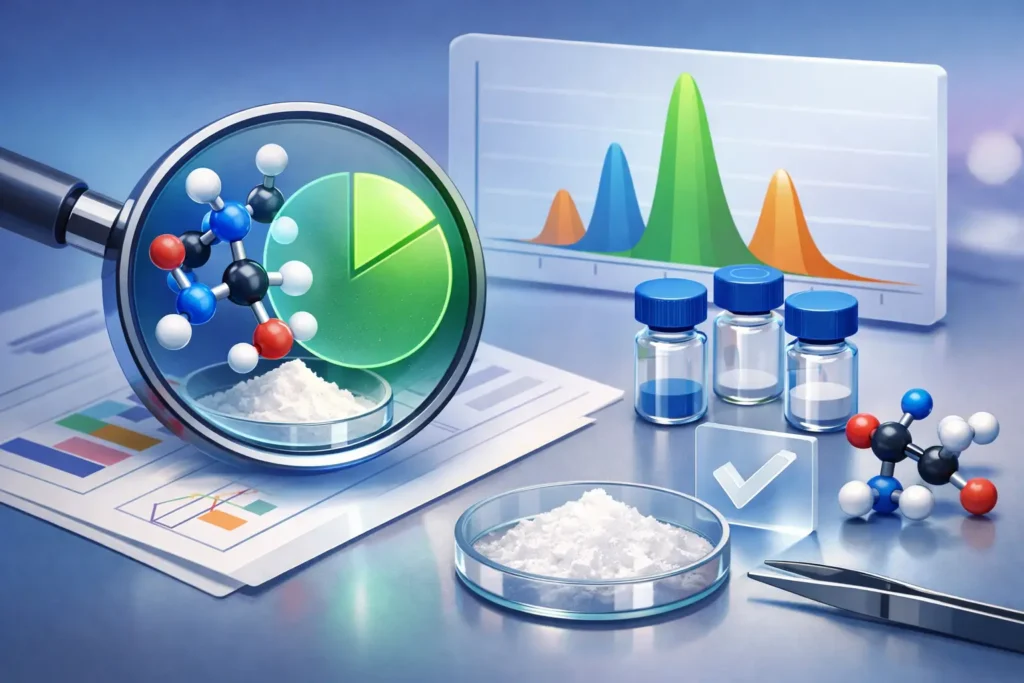
In most peptide workflows, purity is determined using high-performance liquid chromatography. HPLC separates components in a sample based on how they interact with the analytical system, producing peaks on a chromatogram. The area of the main peak is then compared with the total peak area, and purity is expressed as a percentage.

This is where precision matters. A purity figure is method-dependent. The percentage reflects what the selected analytical method can resolve and quantify under those conditions. A COA stating 98.7% purity by HPLC is reporting an analytical result under defined parameters, not an abstract universal truth about the material.

That distinction is especially relevant when comparing suppliers. Two vendors may list similar purity figures, yet the strength of the documentation can differ considerably depending on whether the result is backed by independent third-party analytical testing, whether chromatograms are available, and whether the batch is also verified for identity.

Why purity percent matters in peptide research

For laboratory, analytical, and experimental research use, purity affects reproducibility. If a peptide batch contains a higher level of related impurities, those additional components may influence analytical readouts, storage performance, or consistency between repeat runs. Even when impurity levels are low, they can still matter in methods that are particularly sensitive.

Higher purity does not automatically mean a material is appropriate for every application, but it generally reduces one source of uncertainty. That is why experienced research buyers often screen for both purity and documentation quality before placing an order. They are not only buying a vial label. They are buying confidence in the batch record behind it.

For this reason, quality-focused suppliers provide certificates of analysis as part of a verification workflow, not as a decorative add-on. The goal is straightforward: give the buyer evidence that the batch has been tested and documented in a controlled, traceable manner.

Purity is not the same as identity

This point is often missed. A peptide can show a high purity percentage and still require separate identity confirmation. Purity asks how much of the sample appears to be the main component relative to detectable impurities. Identity asks whether that main component is actually the intended peptide.

Identity is commonly supported by mass spectrometry or comparable analytical techniques. If you only see a purity percentage on a product page, without any mention of identity verification, there is an information gap. For serious research procurement, both should be considered together.

A well-supported COA typically includes the batch number, test method, result, acceptance criteria, and date. Stronger documentation may also include chromatographic data and mass confirmation. That combination provides a much clearer basis for laboratory decision-making than a headline purity claim alone.

How to read the peptide purity percent on a COA properly

Start with the reported percentage, but do not stop there. Look at whether the COA specifies the analytical technique used. HPLC is common, but the method should be stated clearly. Then check whether the result is tied to a batch number that matches the product you are receiving.

Next, review whether identity has been verified separately. A supplier offering independent third-party analytical testing and transparent certificates of analysis is giving you a more reliable documentation chain than one relying only on internal headline claims.

You should also check the date and general presentation of the document. A credible COA is specific, batch-linked, and technically coherent. Vague documents with no batch traceability, no testing method, or no measurable acceptance criteria should be treated cautiously.

What purity percentage is considered good?

There is no single answer that applies to every research setting. It depends on the nature of the peptide, the intended analytical work, and the tolerance of the method being used. That said, many research buyers look for high-purity material, often in the upper 90% range, particularly when consistency and reduced impurity burden are priorities.

Even so, a higher number is not automatically better if the documentation behind it is weak. A properly documented 98% batch with independent verification can be more credible than an unsupported 99.9% claim with no meaningful analytical detail.

This is where procurement discipline matters. The right question is not simply, “Is the number high?” It is, “Is the number supported, traceable, and appropriate for the research requirement?”

Common misunderstandings about peptide purity percent on COA

One misunderstanding is that purity percent refers to potency. It does not. Purity describes composition under the analytical method used. Potency is a different concept and is not interchangeable with purity.

Another misunderstanding is that the remaining percentage is always one specific contaminant. In reality, the non-main fraction can consist of multiple minor components. A 2% impurity profile does not mean one single 2% impurity is present.

It is also incorrect to assume that purity alone reflects how a material has been handled post-testing. Packaging, storage, transport conditions, and dispatch controls matter as well. A properly tested batch still needs controlled handling to preserve its condition through fulfilment and receipt.

Why supplier standards matter as much as the number itself

A purity percentage only has value when the surrounding quality system is dependable. Researchers should look for suppliers that operate with clear batch control, independent analytical verification, secure packaging standards, and transparent documentation practices. These operational details are not secondary. They are part of risk control.

For UK buyers in particular, dependable tracked delivery, discreet fulfilment, and prompt dispatch can also support better handling continuity once a batch leaves storage. Delays and poor packaging introduce avoidable variables. A quality-first supplier reduces those variables through process discipline, not just product claims.

At Precision Peptides, that standard is built around independent third-party analytical testing, verified purity and identity, and certificates of analysis designed to support laboratory documentation workflows. All products are supplied strictly for laboratory, analytical, and experimental research use only, and not for human or animal consumption.

The better question to ask before you order

Instead of asking only what is peptide purity percent on COA, ask what evidence supports the result. A credible answer should include the method used, the batch-specific document, the identity check, and the supplier controls that protect sample integrity before dispatch.

That is how experienced buyers reduce ambiguity. They do not chase the biggest headline figure in isolation. They choose documented, verified material from suppliers that treat quality control as an operating standard rather than a sales phrase.

If a COA helps you verify what was tested, how it was tested, and which batch you are working with, it is doing its job. And if your supplier can provide that level of clarity consistently, your research workflow starts from a stronger position.
Leave a Comment

Your email address will not be published. Required fields are marked *

What Is Peptide Purity Percent on COA?

What Is Peptide Purity Percent on COA?

When a researcher asks what is peptide purity percent on COA, they are usually trying to answer a practical question rather than a theoretical one: can this material be relied on for controlled laboratory work? The purity percentage on a certificate of analysis is one of the first figures serious buyers check, because it helps indicate how much of the sample corresponds to the target peptide versus related impurities, by-products, or degradation material.

That figure matters, but only when read correctly. A COA is not marketing copy. It is a quality document, and the purity result should be interpreted alongside identity testing, batch information, analytical method, storage conditions, and supplier controls. For research use only, that broader context is what supports traceability and reduces avoidable variability in experimental settings.

What is peptide purity percent on COA in simple terms?

Peptide purity percent on a COA is the reported proportion of the analysed sample that matches the main peptide component under the test method used, most commonly HPLC. If a batch is reported at 99% purity, that generally means the dominant detectable material in that analysis is the intended peptide, while the remaining 1% reflects other detectable components.

Those other components can include synthesis-related impurities, truncated sequences, deletion peptides, residual side-products, or compounds formed through handling and storage. In some cases, they may be chemically similar to the target peptide. That is why the purity number is useful, but not self-sufficient. It tells you something important about sample composition, yet it does not by itself prove full identity, stability, or fitness for a specific research protocol.

What a COA purity result actually measures

In most peptide workflows, purity is determined using high-performance liquid chromatography. HPLC separates components in a sample based on how they interact with the analytical system, producing peaks on a chromatogram. The area of the main peak is then compared with the total peak area, and purity is expressed as a percentage.

This is where precision matters. A purity figure is method-dependent. The percentage reflects what the selected analytical method can resolve and quantify under those conditions. A COA stating 98.7% purity by HPLC is reporting an analytical result under defined parameters, not an abstract universal truth about the material.

That distinction is especially relevant when comparing suppliers. Two vendors may list similar purity figures, yet the strength of the documentation can differ considerably depending on whether the result is backed by independent third-party analytical testing, whether chromatograms are available, and whether the batch is also verified for identity.

Why purity percent matters in peptide research

For laboratory, analytical, and experimental research use, purity affects reproducibility. If a peptide batch contains a higher level of related impurities, those additional components may influence analytical readouts, storage performance, or consistency between repeat runs. Even when impurity levels are low, they can still matter in methods that are particularly sensitive.

Higher purity does not automatically mean a material is appropriate for every application, but it generally reduces one source of uncertainty. That is why experienced research buyers often screen for both purity and documentation quality before placing an order. They are not only buying a vial label. They are buying confidence in the batch record behind it.

For this reason, quality-focused suppliers provide certificates of analysis as part of a verification workflow, not as a decorative add-on. The goal is straightforward: give the buyer evidence that the batch has been tested and documented in a controlled, traceable manner.

Purity is not the same as identity

This point is often missed. A peptide can show a high purity percentage and still require separate identity confirmation. Purity asks how much of the sample appears to be the main component relative to detectable impurities. Identity asks whether that main component is actually the intended peptide.

Identity is commonly supported by mass spectrometry or comparable analytical techniques. If you only see a purity percentage on a product page, without any mention of identity verification, there is an information gap. For serious research procurement, both should be considered together.

A well-supported COA typically includes the batch number, test method, result, acceptance criteria, and date. Stronger documentation may also include chromatographic data and mass confirmation. That combination provides a much clearer basis for laboratory decision-making than a headline purity claim alone.

How to read the peptide purity percent on a COA properly

Start with the reported percentage, but do not stop there. Look at whether the COA specifies the analytical technique used. HPLC is common, but the method should be stated clearly. Then check whether the result is tied to a batch number that matches the product you are receiving.

Next, review whether identity has been verified separately. A supplier offering independent third-party analytical testing and transparent certificates of analysis is giving you a more reliable documentation chain than one relying only on internal headline claims.

You should also check the date and general presentation of the document. A credible COA is specific, batch-linked, and technically coherent. Vague documents with no batch traceability, no testing method, or no measurable acceptance criteria should be treated cautiously.

What purity percentage is considered good?

There is no single answer that applies to every research setting. It depends on the nature of the peptide, the intended analytical work, and the tolerance of the method being used. That said, many research buyers look for high-purity material, often in the upper 90% range, particularly when consistency and reduced impurity burden are priorities.

Even so, a higher number is not automatically better if the documentation behind it is weak. A properly documented 98% batch with independent verification can be more credible than an unsupported 99.9% claim with no meaningful analytical detail.

This is where procurement discipline matters. The right question is not simply, “Is the number high?” It is, “Is the number supported, traceable, and appropriate for the research requirement?”

Common misunderstandings about peptide purity percent on COA

One misunderstanding is that purity percent refers to potency. It does not. Purity describes composition under the analytical method used. Potency is a different concept and is not interchangeable with purity.

Another misunderstanding is that the remaining percentage is always one specific contaminant. In reality, the non-main fraction can consist of multiple minor components. A 2% impurity profile does not mean one single 2% impurity is present.

It is also incorrect to assume that purity alone reflects how a material has been handled post-testing. Packaging, storage, transport conditions, and dispatch controls matter as well. A properly tested batch still needs controlled handling to preserve its condition through fulfilment and receipt.

Why supplier standards matter as much as the number itself

A purity percentage only has value when the surrounding quality system is dependable. Researchers should look for suppliers that operate with clear batch control, independent analytical verification, secure packaging standards, and transparent documentation practices. These operational details are not secondary. They are part of risk control.

For UK buyers in particular, dependable tracked delivery, discreet fulfilment, and prompt dispatch can also support better handling continuity once a batch leaves storage. Delays and poor packaging introduce avoidable variables. A quality-first supplier reduces those variables through process discipline, not just product claims.

At Precision Peptides, that standard is built around independent third-party analytical testing, verified purity and identity, and certificates of analysis designed to support laboratory documentation workflows. All products are supplied strictly for laboratory, analytical, and experimental research use only, and not for human or animal consumption.

The better question to ask before you order

Instead of asking only what is peptide purity percent on COA, ask what evidence supports the result. A credible answer should include the method used, the batch-specific document, the identity check, and the supplier controls that protect sample integrity before dispatch.

That is how experienced buyers reduce ambiguity. They do not chase the biggest headline figure in isolation. They choose documented, verified material from suppliers that treat quality control as an operating standard rather than a sales phrase.

If a COA helps you verify what was tested, how it was tested, and which batch you are working with, it is doing its job. And if your supplier can provide that level of clarity consistently, your research workflow starts from a stronger position.

Leave a Comment

Your email address will not be published. Required fields are marked *

Shopping Cart