
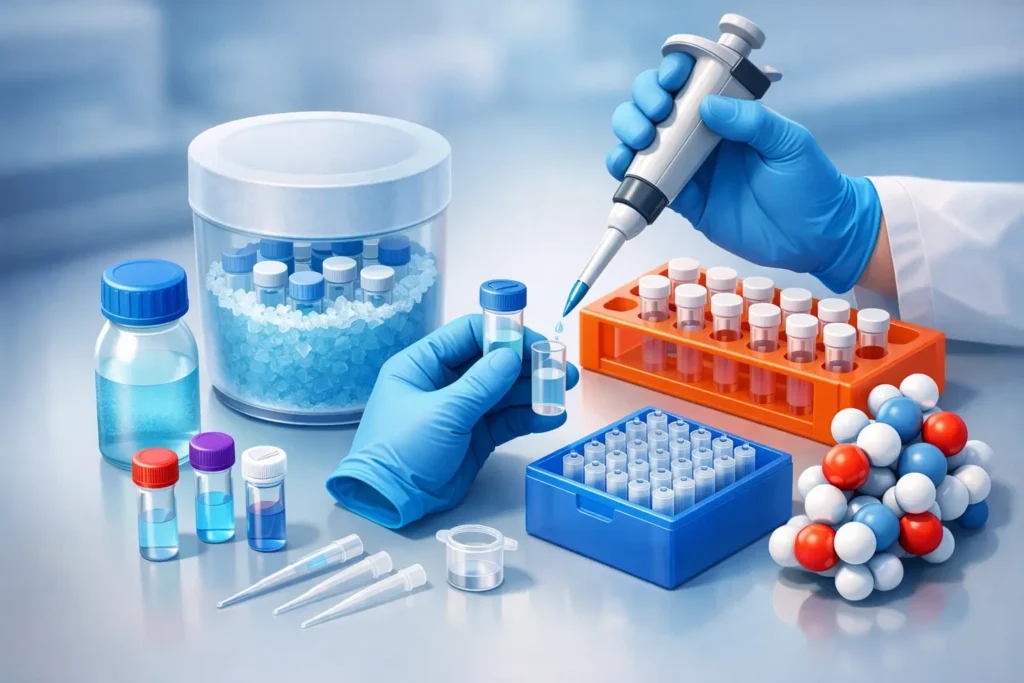
A peptide that tests clean on arrival can still become a variable in your workflow if aliquoting is handled poorly. When researchers ask how to aliquot research peptides, the real issue is usually not convenience – it is preserving integrity, reducing avoidable degradation, and keeping every transfer defensible in the lab record. For research use only, and not for human or animal consumption, peptide handling should always sit inside a controlled, documented laboratory process.
Why aliquoting matters in peptide research
Aliquoting is not simply splitting one vial into smaller portions. It is a control measure designed to limit repeat exposure to moisture, temperature change, light, and contamination. If a research peptide is repeatedly reconstituted, opened, warmed, and returned to storage, the risk to stability increases, even when the compound began with verified purity and identity.
In practical terms, a good aliquoting plan supports reproducibility. It helps ensure that one experimental run is not using material that has been stressed by multiple freeze-thaw cycles while another run is using a freshly prepared portion. That difference can be enough to complicate interpretation, particularly in longer studies or analytical work where consistency between runs matters.
How to aliquot research peptides without compromising the material
The right approach depends on the peptide format, the study design, and the expected storage interval. A lyophilised peptide may be aliquoted before reconstitution in some workflows, while in others the more sensible route is to reconstitute once under controlled conditions and then divide into single-use or low-use volumes. There is no single rule that fits every compound, which is why documentation from the supplier and internal laboratory SOPs should guide the decision.
Before handling begins, prepare the workspace fully. That means labelled secondary vials or tubes, calibrated pipettes, suitable sterile tips, and a clear record of target aliquot volumes. This is the stage where preventable mistakes usually occur. If the receiving containers are not pre-labelled with compound name, batch reference, concentration if applicable, date of preparation, and storage condition, traceability becomes weaker from the first transfer.
If the peptide is to be reconstituted, use only an appropriate research solvent and follow the handling guidance relevant to that compound. Some peptides tolerate standard aqueous reconstitution well, while others may require a more specific approach based on solubility profile and study conditions. Gentle mixing is generally preferred over aggressive agitation. Vigorous shaking can introduce foaming and handling inconsistency, and it is rarely necessary in a controlled lab setting.
Once fully dissolved, transfer the solution into pre-measured aliquots as efficiently as possible. The goal is to create volumes that match your expected use. If each experiment needs 100 microlitres, making 1 millilitre aliquots may sound efficient, but it usually creates unnecessary repeat thawing. Single-use or near-single-use aliquots are often the better choice when stability is a concern.
Choose aliquot size based on actual use
This is where many workflows improve. Researchers often default to evenly split volumes rather than experimentally useful volumes. Better aliquoting starts with your protocol. Ask how much material is required per assay, how often the material will be used, and whether repeat access to the same aliquot is acceptable.
Smaller aliquots reduce waste from freeze-thaw exposure, but there is a trade-off. More aliquots mean more handling time, more tubes, and more opportunities for transfer loss. Very small aliquots can also become harder to recover accurately, particularly with low-volume pipetting. The best aliquot size is usually the smallest volume that remains practical for reliable transfer and aligns with the study schedule.
Keep transfers controlled and documented
Aliquoting should be treated as a traceable event, not an informal bench task. Record the original product identity, lot or batch number, reconstitution solvent, resulting concentration, aliquot volume, number of aliquots created, operator, and storage location. This matters for internal quality control and for any later review where sample history needs to be reconstructed.
For serious research buyers, this is one reason verified sourcing matters at the front end. Starting with a peptide that has independent third-party analytical testing and certificates of analysis gives a firmer base for downstream handling records. Good aliquoting cannot correct poor source material, but it can preserve good material more effectively.
Storage after aliquoting
Aliquoting only helps if storage conditions are then maintained consistently. Once divided, aliquots should be placed into the correct storage environment without unnecessary bench exposure. Exact temperature requirements depend on the peptide and whether it remains lyophilised or has been reconstituted, so supplier guidance and internal validation should take priority.
Repeated warming and cooling should be avoided where possible. If an aliquot is removed for use, it is generally better to use that portion within the planned workflow rather than return partially used material to storage repeatedly. Light-sensitive compounds should be protected appropriately, and condensation risk should be minimised during removal from cold storage.
Container choice also matters more than it is often given credit for. Use clean, suitable research-grade vials or tubes that seal properly and are compatible with the solvent system. A poor seal can introduce evaporation, contamination, or concentration drift over time, which is exactly what aliquoting is supposed to prevent.
Common mistakes when learning how to aliquot research peptides
The most common error is aliquoting without a volume strategy. This creates oversized portions that get thawed multiple times and gradually become less dependable. The second is weak labelling. A tube marked only with an abbreviation may make sense on the day of preparation but cause confusion weeks later, especially in shared laboratory environments.
Another issue is rushing reconstitution. If a peptide is not fully dissolved before transfer, aliquots may not have equal concentration. That can distort assay results in a way that looks like experimental variation but is actually a preparation inconsistency. Equally, using unsuitable solvents or improvised handling steps without reference to known solubility and stability data creates avoidable risk.
There is also a tendency to treat all peptides as though they behave the same way. They do not. Sequence, purity profile, excipient presence, concentration, and storage duration can all alter the best handling approach. A disciplined workflow accepts that peptide-specific judgement is part of good laboratory practice.
Building a more reliable aliquoting workflow
The most reliable systems are simple, repeatable, and written down. Create a standard process for receiving, verifying, logging, reconstituting where required, aliquoting, and storing each peptide format used in your lab. Include acceptance checks against supplier documentation, especially where purity and identity verification support your record set.
For UK laboratories and research-aligned buyers ordering online, speed of fulfilment matters, but so does what happens after delivery. Material should be checked on receipt, matched to its documentation, and integrated into storage without delay. Precision at this stage supports precision later. At Precision Peptides, that same expectation sits behind quality control, verified identity and purity, and tracked delivery practices designed for controlled research workflows.
If your team handles multiple compounds regularly, periodic review is worth the effort. Look at which aliquot sizes lead to waste, which peptides show the most handling sensitivity, and where operator variation appears in records. Small refinements here often have a larger effect on consistency than buying more material or adjusting assay parameters downstream.
A well-aliquoted peptide is not just easier to store. It is easier to trust when results matter, records need to stand up, and every variable that can be controlled should be controlled.