
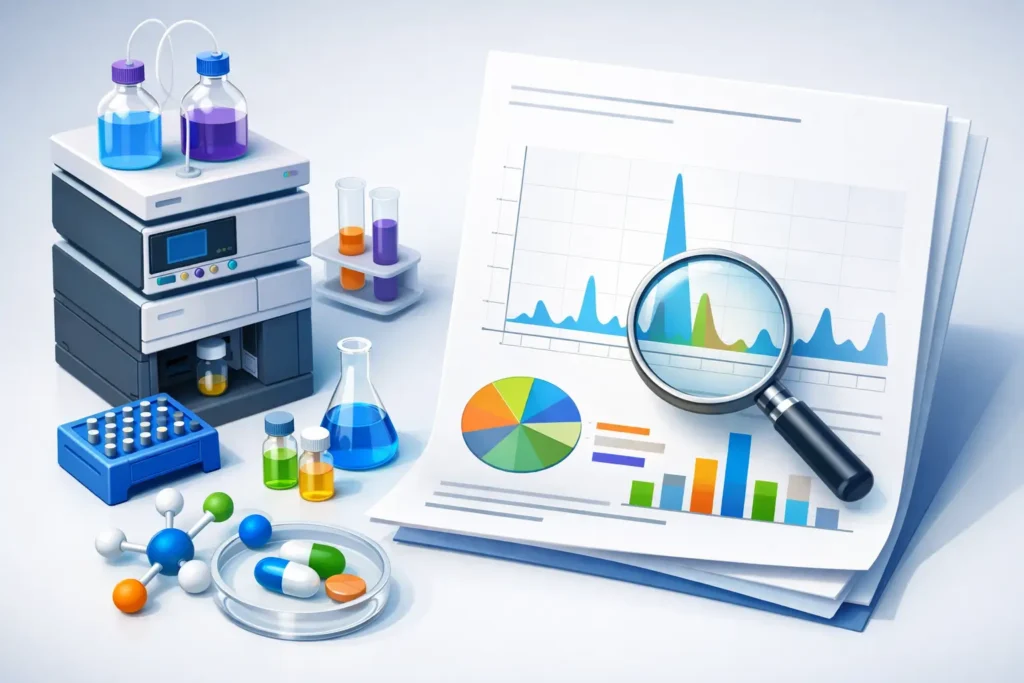
A purity figure on its own tells you very little if you cannot see how it was produced. For research buyers comparing peptide lots, knowing how to interpret HPLC purity report data is part of basic risk control. A reported purity of 99% may look strong at first glance, but the chromatogram, method conditions, integration settings and peak profile decide whether that number is genuinely useful for laboratory decision-making.
For any controlled research workflow, HPLC results should be read alongside identity testing, batch documentation and handling records. Purity is one quality indicator, not the whole file. That matters particularly with research peptides, where a clean-looking report can still leave unanswered questions if the method is poorly described or the peak integration is questionable. All materials discussed here are considered for research use only and not for human or animal consumption.
What an HPLC purity report is actually showing
High-performance liquid chromatography separates components in a sample as they pass through a column. The detector records those components as peaks over time. In a typical purity report, the main peak is assumed to represent the target compound, while smaller peaks represent impurities, by-products, degradation products or matrix-related signals.
The key point is this: HPLC purity is usually a relative measure based on peak area, not a direct statement that every molecule in the vial has been individually confirmed. If the main peak contributes 98.7% of the total integrated area, the report may state 98.7% purity by HPLC area. That can be useful, but only within the limits of the method used.
Different methods can give different purity values for the same material. Gradient programme, mobile phase composition, detector wavelength, column chemistry and sample preparation all affect separation. That is why serious buyers do not treat purity as a floating marketing claim. They look for independent third-party analytical testing and supporting certificates of analysis that show what was actually measured.
How to interpret HPLC purity report sections
Most reports follow a similar structure, even if formats vary between laboratories. You will usually see sample identification, batch or lot number, test date, analyst or laboratory reference, method details, chromatogram image, peak table and a reported purity result.
Start with the sample identification. The report should clearly match the product and lot under review. If the name is vague, the lot is missing, or the date does not align with the batch in hand, the analytical value drops immediately. For research procurement, documentation only works if it is traceable.
Then review the method description. A useful report states enough detail to understand the analytical conditions – for example reverse-phase HPLC, UV detection wavelength, column type, flow rate and injection volume. You do not always need a fully validated pharmacopeial method for routine research purchasing, but you do need enough information to judge whether the test was performed under controlled conditions.
Next, study the chromatogram itself. A chromatogram is not decorative. It shows whether the separation looks clean, whether the baseline is stable and whether peaks are resolved well enough to support the reported percentages. If the main peak is broad, tailing heavily, or merged with adjacent peaks, the purity figure deserves closer scrutiny.
Reading the peak table correctly
The peak table is often where the practical interpretation happens. It usually includes retention time, peak height, peak area and area percentage. For purity assessment, area percentage is the figure most buyers focus on.
Retention time tells you when a component eluted from the column. The main peak should appear consistently near the expected retention time for that method. A shift does not automatically mean failure, but unexplained movement can suggest method variation, column condition issues or sample instability.
Peak area is proportional to detector response. Area percentage represents each peak’s share of the total integrated signal. If the main peak area percentage is 99.2%, the report may state 99.2% purity by area. Smaller peaks listed at 0.1%, 0.2% and 0.5% make up the remainder.
What matters here is not just the top-line number but the impurity pattern. One isolated impurity at 0.8% may be acceptable for some research applications. Several unresolved low-level peaks spread across the run may matter more, particularly where reproducibility or downstream analytical work depends on a tightly characterised material.
Main peak does not always equal confirmed identity
This is a frequent mistake. In many routine reports, the largest peak is treated as the target compound. That is a practical convention, not absolute proof. HPLC purity alone does not fully establish identity. A material may show one dominant peak yet still require confirmation by mass spectrometry or another orthogonal method.
For peptide research, identity verification is a separate control point. If a supplier states that material is verified for purity and identity, that is more meaningful than an HPLC trace alone. The strongest documentation packages pair chromatographic purity with mass confirmation and lot-specific records.
What a good chromatogram looks like
A useful HPLC purity report usually shows a stable baseline, a clearly dominant main peak and sensible separation from minor peaks. The baseline should not wander excessively or show significant noise, because unstable baseline behaviour can distort integration. The peak shape should also be reasonably symmetrical. Severe fronting or tailing can indicate overloading, matrix effects or method issues.
Resolution matters as well. If two peaks are too close together, the software may integrate them inaccurately as one peak or split them inconsistently. That directly affects purity percentage. This is one reason why a high reported number is not always better than a slightly lower number from a cleaner, better-resolved method.
If the chromatogram image is tiny, blurred or cropped, that is not ideal. A serious report should allow visual review. Researchers should be able to assess whether the analytical presentation matches the written claim.
Common traps when reviewing HPLC purity
The most common trap is treating area percentage as absolute composition. Detector response is compound-dependent. Some impurities absorb more strongly or more weakly at the chosen wavelength than the target material. That means area normalisation can understate or overstate actual mass percentage.
Another trap is ignoring the limit of detection. If an impurity sits below the method’s reporting threshold, it may not appear prominently in the result. That does not mean the sample is impurity-free. It means the method may not reliably quantify below a certain level.
You should also be cautious with reports that omit integration parameters. Integration can materially change reported purity. A manually adjusted baseline, selective thresholding or exclusion of small peaks can push the main peak percentage upwards. Without a credible laboratory process, that creates room for inconsistency.
Age and storage history matter too. A clean report from months ago may not reflect the current state of a sensitive research material if storage and handling were poor. Purity is not just a manufacturing issue. It is also a stability issue.
How to judge whether the purity result is fit for your research
The right question is not simply, “Is 98% good?” The right question is, “Is this result fit for the intended analytical or experimental use?” That depends on the work.
For some early-stage laboratory screening, material with a lower but well-characterised purity may be acceptable if the impurity profile is understood and consistent between lots. For reference work, calibration-sensitive studies or experiments where trace contaminants could affect outcome, tighter specifications may be necessary.
This is where documentation quality becomes commercially important. A supplier that provides lot-specific certificates of analysis, independent third-party analytical testing and clear batch traceability reduces ambiguity. Precision matters not because it looks good in a product listing, but because it supports reproducibility and lowers avoidable risk in the lab.
If you are reviewing a peptide batch for purchase, ask whether the report is lot-specific, whether identity was confirmed independently, whether the chromatogram is readable, and whether the method gives enough context to trust the number. A clean file is part of controlled procurement.
How to interpret HPLC purity report data in practice
In practice, read the report in order. Confirm the lot, confirm the date, review the method, inspect the chromatogram, then examine the peak table. After that, compare the reported purity with the impurity pattern rather than treating the headline figure as the whole answer.
If anything looks incomplete, ask for clarification before using the material in research. A credible supplier should be able to provide documentation that supports the claim being made. On a quality-led platform such as Precision Peptides, that means certificates of analysis are not just sales support – they are part of the verification chain serious research buyers rely on.
The best habit is simple: never read an HPLC purity number in isolation when the chromatogram is available. The real value is in the detail, and careful reading at the point of purchase is usually far easier than troubleshooting inconsistent results after the work has already started.
A strong report does not remove every uncertainty, but it gives you something far better than assumption – traceable evidence you can actually use.