
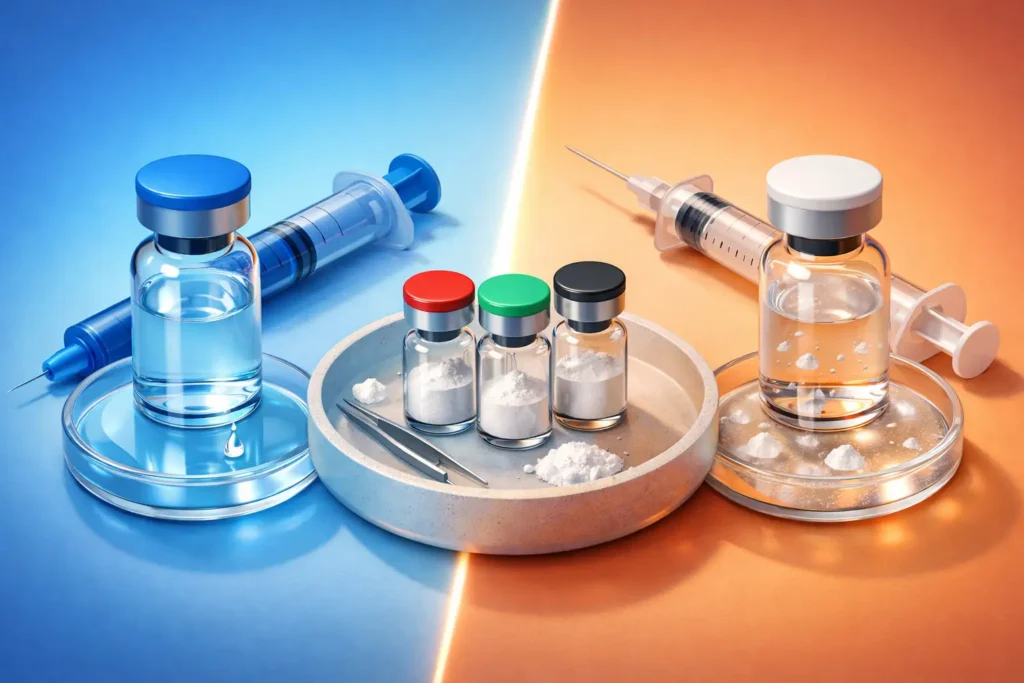
A reconstituted peptide can fail long before the assay begins. In many lab settings, the real issue is not the peptide lot itself, but the diluent choice, handling sequence, and storage discipline that follow. When comparing bacteriostatic water vs saline for peptide reconstitution, the right answer depends on the peptide, the planned use window, and how tightly your research workflow controls contamination risk. For research use only, and not for human or animal consumption, this is a decision that should be made with the same care applied to purity verification, identity testing, and documentation.
Bacteriostatic water vs saline for peptide reconstitution: the practical difference
At a basic level, both are sterile aqueous diluents, but they behave differently in a research environment. Bacteriostatic water is sterile water containing a bacteriostatic preservative, typically benzyl alcohol, intended to inhibit bacterial growth after first entry. Saline is sterile sodium chloride solution, usually at 0.9%, and does not typically include that preservative.
That difference matters because peptide reconstitution is not only a chemistry question. It is also a handling and storage question. If a vial will be used once, immediately, and under tightly controlled conditions, saline may be acceptable for some research workflows. If a vial may be entered more than once over a short storage interval, bacteriostatic water is often preferred because it adds a layer of practical protection against microbial contamination introduced during handling.
This does not make bacteriostatic water universally better. Some peptides are sensitive to formulation conditions, and the presence of benzyl alcohol may be unsuitable for particular compounds or experimental designs. Saline, meanwhile, changes ionic strength, which can improve solubility for some materials and reduce it for others. The decision is peptide-specific.
Why diluent choice affects more than solubility
Researchers sometimes reduce this question to whether the powder dissolves cleanly. That is only part of the picture. Reconstitution influences concentration accuracy, pH environment, repeat handling, adsorption behaviour, and the likelihood of degradation over time.
A peptide that appears fully dissolved may still lose integrity more quickly in one diluent than another. Another may remain stable enough in either medium but show different behaviour once refrigerated, transferred, or exposed to repeated temperature cycling. This is why serious buyers prioritise third-party analytical testing, lot documentation, and controlled handling standards from the start. Reconstitution is one step in a chain of reliability, not a standalone task.
Where bacteriostatic water tends to fit best
Bacteriostatic water is often selected when the research protocol involves multi-use handling over a limited period. The preservative can help reduce contamination risk from repeated vial access, which makes it a pragmatic option in labs that prepare aliquots or return to the same vial more than once.
It is also frequently chosen when researchers want a neutral aqueous medium without added salts. For some peptides, that simpler matrix is desirable during early handling or stock preparation. In these cases, the absence of sodium chloride may reduce one variable in the workflow.
However, bacteriostatic water is not automatically the most stable environment for every peptide. The preservative can interact unfavourably with certain compounds, and researchers should always check available manufacturer guidance, analytical data, and internal compatibility records before standardising a process.
Where saline may be the better option
Saline can be useful where isotonic or ionic conditions are relevant to the research method, or where the peptide demonstrates stronger solubility or more consistent handling performance in the presence of sodium chloride. Some labs also prefer saline for immediate-use preparations where the solution will be used promptly and not stored after repeated entry.
The trade-off is straightforward. Saline generally lacks the bacteriostatic preservative that makes multi-entry handling more forgiving. That means aseptic discipline becomes even more important. If a vial is re-entered several times, the contamination risk rests much more heavily on technique, storage, and timing.
Stability, contamination risk and storage discipline
If the question is purely bacteriostatic water vs saline for peptide reconstitution, bacteriostatic water often has the advantage in practical storage management. It can offer a wider margin for handling error after first puncture, particularly in busy research environments where a stock solution may not be consumed in a single session.
That said, no preservative compensates for poor practice. Reconstituted peptides should still be handled with sterile equipment, minimal exposure time, and properly controlled refrigeration or freezing according to the peptide’s characteristics and the protocol in use. Repeated warming and cooling, unnecessary agitation, and imprecise volumetric work are common sources of avoidable variability.
Saline can perform well when preparation and use are tightly time-bound. If the solution is made fresh, used promptly, and not repeatedly accessed, the lack of preservative may be less relevant. In that scenario, the more important considerations may be peptide compatibility and assay-specific performance.
Solubility is peptide-specific, not rule-based
One of the most common mistakes is assuming one diluent works across the board. Peptides vary widely in sequence, charge, hydrophobicity, and susceptibility to aggregation. A compound that reconstitutes cleanly in bacteriostatic water may behave poorly in saline. Another may do the opposite.
Hydrophobic peptides may require a more staged approach, sometimes involving initial dissolution under carefully controlled conditions before dilution to the target working medium. More delicate materials may benefit from gentle swirling rather than vigorous shaking, which can increase foaming or surface adsorption. Even the order of addition can matter.
For that reason, a blanket answer is rarely the most reliable one. A well-run lab treats reconstitution as part of method control. The peptide identity, target concentration, storage duration, and analytical endpoint all deserve consideration before settling on a standard diluent.
A compliance-forward approach to reconstitution
For professional research buyers, documentation matters as much as convenience. The most reliable workflows start with verified materials, clear lot traceability, and controlled handling from receipt through use. That means sourcing peptides verified for purity and identity, supported by independent third-party analytical testing and certificates of analysis, then pairing them with appropriate sterile supplies.
In practice, reconstitution should be recorded with the same precision applied elsewhere in the lab. Note the diluent type, volume added, final concentration, date and time of reconstitution, storage conditions, and any visible changes such as hazing or particulate formation. If a peptide behaves differently after dilution, that information is valuable for repeatability and troubleshooting.
This is also where supplier standards make a difference. Precision in packaging, controlled handling, and dependable fulfilment reduce the number of variables entering the lab before the vial is ever opened. For researchers working to planned timelines, secure and tracked delivery is not merely a retail convenience. It supports experimental continuity.
How to choose between bacteriostatic water and saline
A practical decision usually comes down to four questions. Will the vial be used once or multiple times? Does the peptide show known compatibility with one medium over the other? Is the study sensitive to preservatives or ionic strength? And how controlled is the storage and handling environment after reconstitution?
If multi-use handling is likely, bacteriostatic water is often the safer operational choice. If the preparation is immediate-use and the peptide performs better in saline, saline may be more appropriate. If compatibility data are limited, start conservatively, work from documented evidence, and avoid assuming that ease of dissolution equals long-term stability.
It is also sensible to avoid over-reconstitution. Preparing more solution than the protocol needs increases waste and often increases degradation risk through repeated access. Smaller, well-documented aliquots usually support better consistency.
The better question is not which is best, but which is controlled
There is no universal winner in bacteriostatic water vs saline for peptide reconstitution. Bacteriostatic water often offers stronger protection against contamination during repeated handling, while saline may better suit certain peptide characteristics or immediate-use methods. The right choice is the one that aligns with the peptide’s known behaviour and the realities of your research workflow.
For serious laboratory buyers, the most dependable outcome comes from controlling the full chain – verified peptide quality, sterile technique, accurate volumetrics, appropriate storage, and disciplined record-keeping. When those pieces are in place, diluent choice becomes a documented research decision rather than a guess. That is where reproducibility starts.