
A peptide can leave the manufacturing environment verified for purity and identity, then lose value on the bench through avoidable handling errors. That is why peptide storage guidelines matter in any serious research setting. For laboratories and research buyers working to protect sample integrity, storage is not an afterthought – it is part of the control system.
For research use only, and not for human or animal consumption, peptides should be handled with the same discipline applied to sourcing and documentation. Independent third-party analytical testing and certificates of analysis establish a baseline at release, but day-to-day storage conditions determine whether that baseline is preserved. If temperature, moisture or repeated disturbance are poorly managed, reproducibility can suffer even when the original material met specification.
Why peptide storage guidelines affect research outcomes
Peptides are not all equally stable. Sequence, chain length, terminal modifications, physical form and intended analytical timeframe all influence how quickly a material may degrade under ordinary laboratory conditions. Some compounds tolerate short bench exposure with little consequence. Others are more sensitive to hydrolysis, oxidation, light or repeated freeze-thaw stress.
That variability is exactly why blanket assumptions create risk. A researcher may treat every vial the same way, yet one material remains stable while another drifts outside the condition expected at receipt. Good peptide storage guidelines reduce that uncertainty by aligning handling with the known vulnerabilities of the compound and the pace of the study.
There is also a documentation point here. If storage conditions are inconsistent or poorly recorded, it becomes harder to interpret unusual assay results. Was the signal change real, or did the sample degrade between receipt and use? Strong storage practice supports traceability as much as it supports chemical stability.
Peptide storage guidelines for dry, unreconstituted material
In most cases, dry peptide powder is more stable than reconstituted material. That does not mean it is invulnerable. The main threats are moisture ingress, unnecessary temperature fluctuation and contamination introduced during repeated handling.
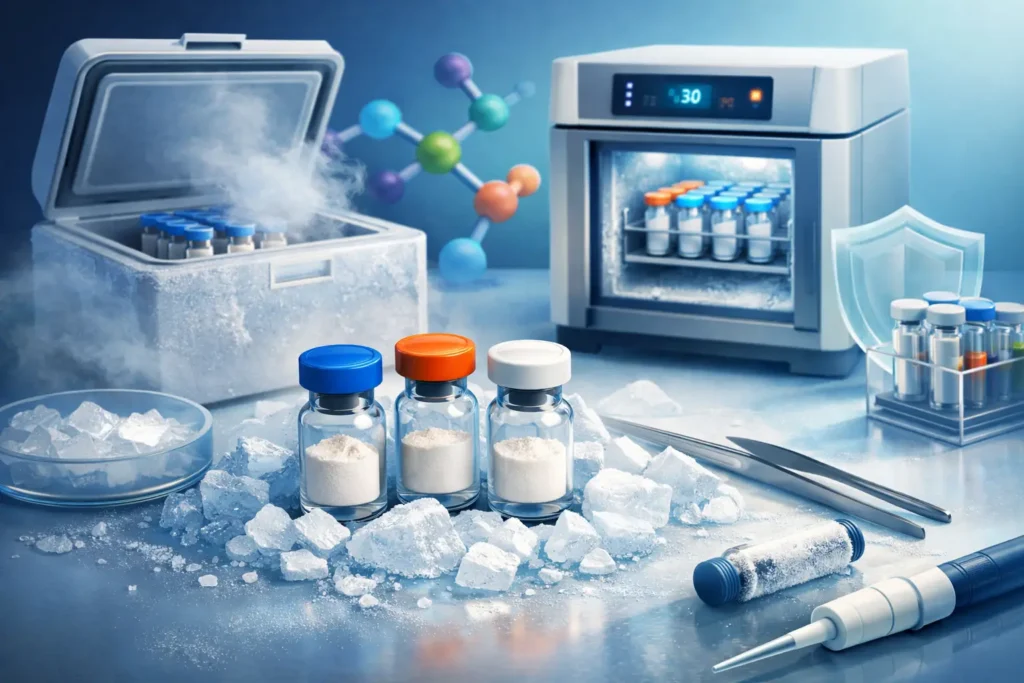
Where product-specific guidance is supplied, that guidance should always take priority. As a general laboratory rule, unreconstituted peptides are typically best stored sealed, protected from light where relevant, and kept at the recommended low temperature as soon as received. For short holding periods, some materials may tolerate refrigerated conditions. For longer-term retention, frozen storage is often preferred.
The key issue is consistency. Moving a vial from room temperature to the fridge, then to the freezer, then back out again, adds condensation risk and creates avoidable variability. If a material is being held for future work, place it promptly into its intended storage condition and minimise subsequent disturbance.
Original packaging also matters more than many buyers assume. Controlled packaging helps reduce exposure to humidity and handling contamination during transit and initial receipt. Once opened, that protection depends on the researcher. If the vial is left uncapped, handled in a damp environment or returned to storage after prolonged exposure, the chain of control weakens immediately.
Refrigeration versus freezing
There is no single temperature rule that fits every peptide. Refrigeration may be acceptable for near-term use when the material is expected to be consumed within a short experimental window. Freezing is more commonly used where the peptide must remain stable over longer periods.
The trade-off is practical. Freezers offer greater protection for many compounds, but each retrieval increases the chance of temperature cycling and condensation if aliquoting has not been planned. Refrigeration can reduce handling friction for active projects, yet may not provide enough protection for prolonged storage. The right choice depends on the compound, the study schedule and whether the material will be opened repeatedly.
After reconstitution, stability becomes more fragile
Once a peptide is in solution, the margin for error narrows. Water-based environments can accelerate degradation pathways, and contamination risk rises each time the container is accessed. For that reason, reconstitution should be timed around actual experimental need rather than done speculatively.
Researchers should use a suitable solvent based on the peptide’s chemistry and intended analytical use. If bacteriostatic water or another laboratory-grade solvent is chosen, compatibility should be confirmed before preparation. Poor solvent selection can create solubility issues, visible particulates or changes in stability that are then misread as product defects.
Reconstituted material is usually best stored cold and used within a defined timeframe set by internal protocol or product-specific guidance. Holding a solution for convenience may save time in the moment, but it can introduce more variability than preparing smaller, fresh aliquots. In controlled research work, convenience should not outrank stability.
Aliquoting reduces avoidable stress
One of the most practical peptide storage guidelines is to aliquot reconstituted material into single-use or low-use portions. This limits repeated freeze-thaw exposure and reduces the number of times the primary stock is opened.
Aliquoting also supports cleaner records. Each portion can be labelled with concentration, solvent, date of reconstitution and storage temperature. That simple step makes downstream review easier and helps protect against one of the most common bench errors – using a stock of uncertain age or concentration.
The main risks that compromise peptide quality
Most storage failures are not dramatic. They come from ordinary lapses repeated over time. A vial sits out during setup. Labels become incomplete. A freezer door is opened frequently. Reconstituted stock is thawed, sampled and refrozen several times because aliquots were never prepared.
Moisture is a frequent issue, especially with lyophilised material. If cold vials are opened before equilibrating appropriately in a dry, controlled setting, condensation can be introduced at the point of access. Oxidation can be relevant for susceptible sequences, particularly where air exposure and light are not controlled. Mechanical handling matters too. Vigorous agitation is not always necessary and may be unhelpful for some preparations.
None of this suggests that every peptide will fail under minor deviation. It means that reliable research depends on reducing preventable variables. The more expensive or time-sensitive the study, the less tolerance there should be for casual storage practice.
Handling and documentation standards that support control
Strong storage practice is operational, not just theoretical. On receipt, inspect the shipment promptly, confirm the product identity against accompanying documentation and transfer material to the intended storage condition without delay. Record lot details, receipt date and any relevant storage notes in the laboratory system used for traceability.
Labels should remain legible and specific. “Peptide in freezer” is not a useful record. Concentration, solvent, aliquot date, lot reference and operator initials provide a much clearer chain of custody. If a deviation occurs, such as prolonged room-temperature exposure or a freezer fault, record it. An honest deviation log is far more useful than an assumed clean history.
For buyers who prioritise verification, storage records belong alongside certificates of analysis and receipt documentation. A verified peptide at dispatch still requires verified handling after delivery. This is where disciplined suppliers and disciplined laboratories complement one another.
What to look for from a supplier
Good peptide storage guidelines start before the parcel arrives. Suppliers should provide clear product handling information, controlled packaging, documented identity and purity verification, and a compliance-forward framework that makes research boundaries explicit. That combination helps reduce ambiguity at the point of receipt.
Precision Peptides operates on that reliability-first basis, with independent third-party analytical testing and certificates of analysis supporting product verification for research use only. For qualified buyers, that matters because storage and handling decisions are easier to defend when the incoming material is properly documented from the outset.
Even then, supplier quality does not replace laboratory control. Fast, tracked delivery and discreet fulfilment reduce transit risk, but once the material is accepted by the researcher, storage responsibility transfers immediately.
When standard storage advice is not enough
Some situations require more caution than a general rule can provide. Peptides with known instability, unusual modifications or demanding assay conditions may need tighter controls, shorter hold times or compound-specific solvent selection. Equally, a small academic lab and a high-throughput research environment may not handle stock access in the same way.
That is why the best peptide storage guidelines are practical rather than absolute. Use product-specific instructions where provided. Match storage conditions to the physical form of the material and the expected duration of use. Aliquot early if repeat access is likely. Keep records that can withstand scrutiny. And if there is uncertainty, treat that uncertainty as a reason to tighten control, not relax it.
Careful storage rarely gets credit when a study runs smoothly, but it is often one of the reasons it does. Protect the sample properly, and the data has a better chance of reflecting the research rather than the handling.