
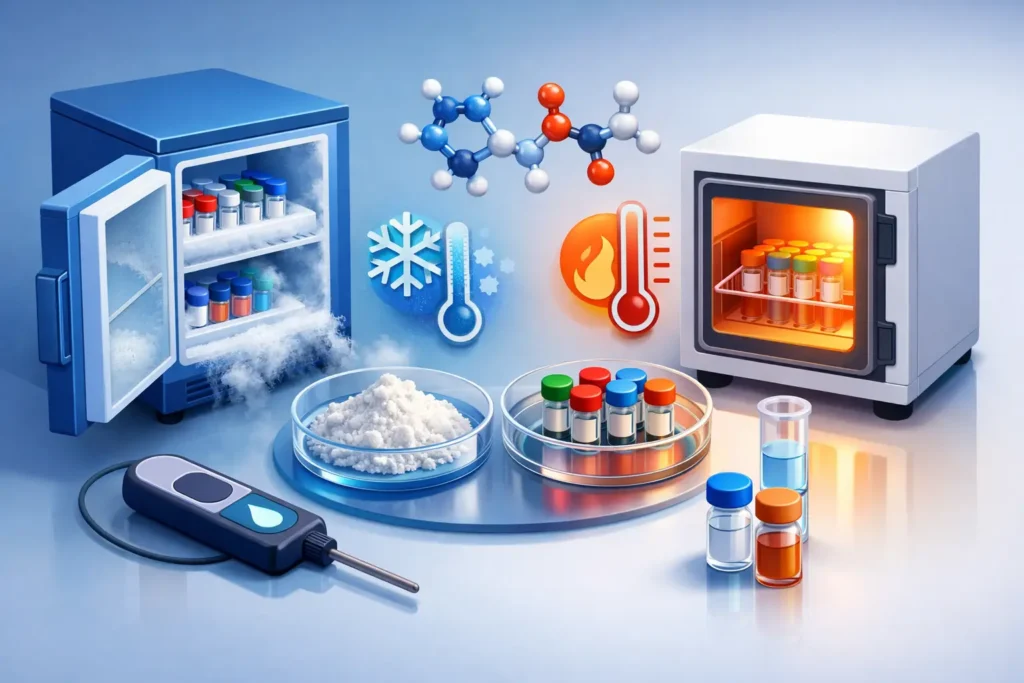
A temperature excursion can undermine a carefully planned experiment long before the material reaches the bench. The relevant question is not simply whether a peptide was kept cold, but whether its storage conditions remained controlled, documented and appropriate to its specific format. This peptide storage temperature guide sets out a practical framework for protecting research materials from receipt through to use in laboratory, analytical and experimental settings.
All products supplied by Precision Peptides are strictly for laboratory, analytical and experimental research use only. They are not for human or animal consumption. Product labels, accompanying documentation and certificates of analysis should always take precedence over general handling guidance.
Peptide Storage Temperature Guide: Start With the Product Record
There is no single storage temperature that applies to every peptide. Stability depends on the compound, its sequence and formulation, whether it is supplied as a dry lyophilised material or prepared in solution, the container closure and the intended duration of storage. Treating every vial identically is convenient, but it can introduce avoidable variability.
Before placing a product into a refrigerator or freezer, review the label and all supplied documentation. Record the product name, batch or lot number, receipt date, stated storage condition and any handling notes in the laboratory inventory. If the material is being incorporated into a controlled study, link that record to the relevant certificate of analysis and experimental file.
This first step matters because verified identity and purity documentation supports more than supplier qualification. It helps laboratories maintain traceability when comparing results, investigating unexpected analytical data or repeating an experiment months later. A clearly labelled vial in a properly logged location is more useful than a material that has merely been kept cold.
Match the Storage Condition to the Material Format
Dry, lyophilised peptides are often more stable than the same materials in solution, but this should not be treated as a universal rule or an invitation to ignore the label. Moisture, oxygen, light and repeated changes in temperature may all affect material quality. A low temperature may slow some degradation pathways, while poor container management can still compromise the sample.
Where refrigerated storage is specified, a monitored refrigerator operating within the stated range is appropriate. Avoid storing research materials in refrigerator doors, where temperature changes are typically greater, or alongside laboratory items likely to create frequent access and disturbance. A dedicated, clearly organised shelf or secondary container reduces both mix-ups and unnecessary handling.
Where frozen storage is specified, use a freezer capable of maintaining the required range consistently. The difference between a standard freezer and a lower-temperature unit can be material, so the product-specific requirement should guide the decision. Do not assume that colder is automatically better. Storage outside the documented range may introduce risks that have not been assessed for that particular material or presentation.
For materials specified for controlled room-temperature storage, the priority is protection from heat sources, direct light and uncontrolled humidity. A bench near a radiator, window or instrument exhaust is not a controlled environment. Use a clean, dry storage area with limited temperature fluctuation and retain the original packaging where it provides light or moisture protection.
Control Temperature Excursions at Receipt
Delivery is a handover point, not the end of the cold-chain question. On receipt, inspect the outer packaging and temperature-control components where supplied. Confirm that the shipment corresponds to the order, check vial integrity and review the label before transferring the material to its designated storage location.
An ambient or warm-feeling parcel does not, by itself, establish that a material is unusable. Equally, it should not be dismissed without assessment when the product requires temperature control. The relevant facts are the product’s stated conditions, the duration and likely severity of the excursion, the condition of the package, and any available transit information.
Document the observation promptly. Photograph visible damage where appropriate, retain the packaging until the issue is clarified, and segregate material that may have been affected from released stock. Do not make assumptions about suitability based only on appearance. A peptide can remain visually unchanged despite a condition that may affect analytical performance.
For UK research buyers, planned delivery arrangements are part of good storage practice. Arrange for someone authorised to receive the parcel, particularly during warm periods, weekends or site closures. Secure, discreet tracked delivery supports accountability, but prompt transfer into the specified environment remains the laboratory’s responsibility after receipt.
Reduce Freeze-Thaw and Handling Variability
Repeated warming and re-cooling can create inconsistency, particularly for prepared solutions. If a research protocol requires the same material at multiple time points, plan the workflow before opening the vial. Where scientifically appropriate and permitted by the product documentation, preparing small, clearly identified working portions can reduce repeated access to the primary material.
The goal is not to add unnecessary process. It is to prevent a vial from being repeatedly removed, opened, handled and returned to storage without a record. Each event can introduce time at uncontrolled temperature, condensation risk and the possibility of labelling errors.
Use a consistent approach across the study. Record preparation date, solvent or matrix used where applicable, concentration, operator initials and assigned storage location. Any prepared solution should be treated as a distinct research sample with its own handling history, rather than as an extension of the unopened original vial.
Avoid placing a cold vial straight into a humid work area and opening it immediately if condensation is likely. Moisture exposure can be particularly relevant for dry materials. Allowing sealed containers to equilibrate in accordance with established laboratory procedures helps reduce this risk. Once opened, minimise exposure time and reseal the container correctly.
Use Equipment That Can Demonstrate Control
A refrigerator or freezer display is not the same as a verified temperature record. For higher-value materials, longer-term studies or work requiring reproducibility, use calibrated or suitably checked monitoring equipment and maintain records that can be reviewed. At a minimum, laboratories should know whether their storage unit has remained within the required operating range.
Alarmed monitoring is especially useful outside staffed hours. It provides an opportunity to act when a door has been left ajar, a unit is overloaded, a power issue occurs or equipment begins to fail. The appropriate response should be written into the laboratory’s deviation process, including who is contacted, how affected materials are identified and what information is recorded.
Organisation within the unit also affects control. Do not overload shelves to the point that air circulation is impaired. Keep materials in labelled secondary containers, separate research compounds from food or unrelated laboratory stock, and maintain a location map where inventory volume justifies it. These basic controls reduce searching time and therefore reduce unnecessary temperature exposure.
When Storage Guidance Is Unclear
Do not fill a gap in the documentation with internet convention. Broad statements such as “keep all peptides at minus 20 degrees Celsius” are not a substitute for product-specific direction. Different compounds, formulations and packaging systems can have different requirements, and the supplier’s stated condition remains the relevant reference point.
If the product label and paperwork appear inconsistent, quarantine the material from active use until the discrepancy is resolved. Keep the batch details, photographs of the label and receipt information available when requesting clarification. This protects the integrity of the investigation and ensures the laboratory is working from a documented decision rather than an assumption.
The same principle applies after an incident. A power outage, refrigeration failure or suspected warm transit event should trigger assessment against the product record, not an automatic decision based on habit. Where the impact cannot be determined from available information, clearly document the uncertainty in the study record.
Storage Discipline Supports Defensible Results
Temperature control is one element of a wider quality system. Independent third-party analytical testing, verified purity and identity, certificates of analysis, careful fulfilment and secure handling all support confidence at the point of supply. Within the laboratory, that confidence is maintained through clear labelling, traceable inventory, appropriate equipment and disciplined sample handling.
Precision Peptides provides research materials for customers who value that chain of control. On receipt, retain the documentation supplied with each batch and incorporate it into the laboratory’s own records. Storage logs should show not only where a material is held, but also why that condition was selected and whether any deviation occurred.
The most useful storage practice is the one a colleague can understand and verify without relying on memory. When every vial has a defined condition, a traceable history and a documented response to exceptions, temperature becomes a controlled experimental variable rather than an avoidable source of doubt.