
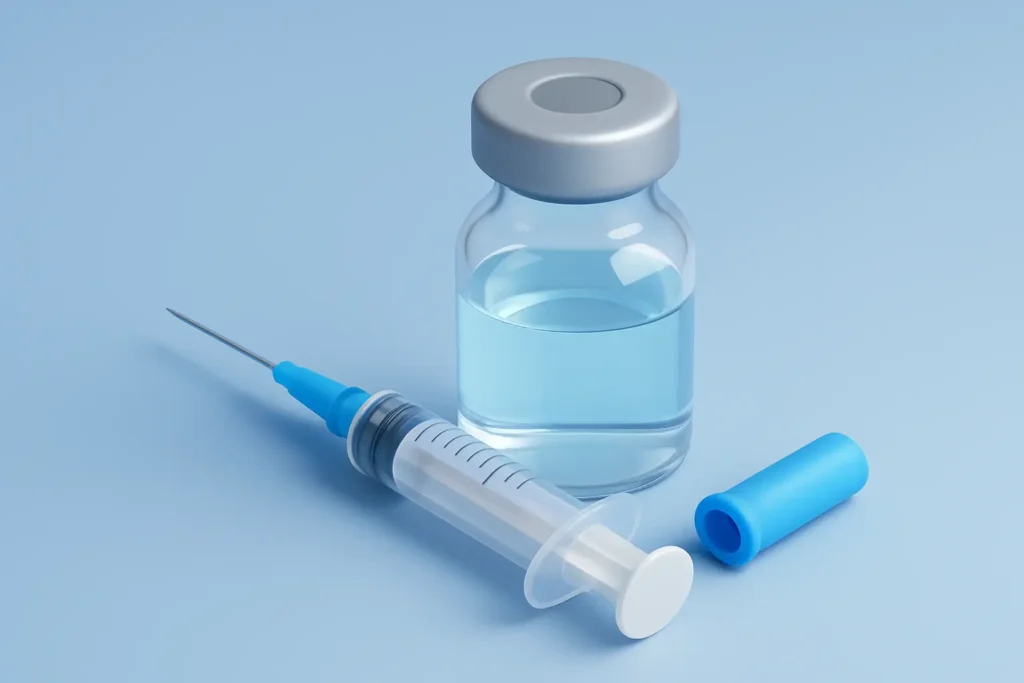
If you run peptide-facing workflows, the smallest consumable can be the difference between a clean, repeatable reconstitution step and a frustrating round of failed controls. Bacteriostatic water in a 10ml sterile vial is one of those deceptively simple items: easy to overlook until you need consistency, documented handling, and a format that supports multi-use access under controlled conditions.
What bacteriostatic water 10ml sterile actually is
Bacteriostatic water is sterile water for injection that contains a bacteriostatic agent, most commonly benzyl alcohol at a low concentration (typically 0.9%). The purpose is not to “sterilise” something that is already contaminated, and it is not a substitute for aseptic technique. The point is risk reduction: the bacteriostatic agent helps inhibit bacterial proliferation if the vial is accessed more than once.
The “10ml sterile” part is practical rather than scientific. A 10ml vial is a common lab-friendly volume that fits standard storage workflows, reduces repeated container changes, and suits measured, repeatable additions during reconstitution or dilution steps.
In a research setting, bacteriostatic water is frequently selected when you need a sterile diluent that will be drawn from multiple times across a short timeline, with clear labelling and consistent concentration of preservative.
Why researchers choose bacteriostatic over plain sterile water
The decision is rarely ideological. It depends on your workflow, your access frequency, and what you are trying to control.
Plain sterile water (with no preservative) is often preferred for single-use transfers where the container will be opened once and discarded, or where any preservative could interfere with a sensitive assay. Bacteriostatic water is commonly preferred when you will puncture the vial multiple times and want an additional safeguard against microbial growth between accesses.
That trade-off matters. Benzyl alcohol can be incompatible with certain analytical or biological systems, particularly if your downstream work is highly sensitive to additives or you are running controls that could be confounded by trace solvents. In those cases, sterile water or another validated diluent may be the correct choice, and the right answer is whichever option preserves interpretability of your data.
Typical lab use cases for bacteriostatic water (and where it may not fit)
In peptide-aligned research workflows, bacteriostatic water 10ml sterile is commonly used as a controlled diluent during reconstitution steps where a lyophilised compound is brought into solution and subsequently aliquoted. The multi-access vial format supports repeat withdrawals without forcing you to open a fresh container each time.
It may also be used for dilution series preparation where a consistent diluent is needed across multiple tubes, particularly when you want to reduce the risk of microbial growth during short-term handling.
Where it may not fit is equally important. If your downstream method is extremely preservative-sensitive, or if your documentation requires a diluent without bacteriostatic agents, you should not default to bacteriostatic water out of habit. “Sterile” does not mean “universally suitable”, and a preservative can be a variable.
Reading the label properly: sterile is not the whole story
For serious research buyers, “sterile” is a baseline, not a differentiator. What you actually want to verify is the full specification and whether it matches your protocol and documentation requirements.
Start with the container format and intended access pattern. Multi-dose vials are designed to be entered more than once, but that assumption only holds if you keep puncture technique consistent and maintain controlled storage.
Next, confirm the bacteriostatic agent and its concentration. Benzyl alcohol at 0.9% is common, but you should still verify what you are buying, because “bacteriostatic” is a functional description and the preservative system is the operational detail.
Finally, check the batch documentation pathway available from the supplier. If your lab needs traceability, you want the ability to align incoming stock with internal records and any supporting documentation.
Handling bacteriostatic water 10ml sterile in a controlled workflow
A bacteriostatic agent is not permission to relax technique. It is an additional control layer, not the control layer.
Use standard aseptic handling practices every time you access the vial. That includes treating the vial stopper as a critical surface, using sterile needles and syringes, and avoiding unnecessary time with the vial exposed. If your SOPs call for swabbing the septum prior to entry, keep that step consistent and document deviations.
Access patterns matter more than most people admit. Multiple punctures with inconsistent technique can introduce variability, particularly if your work involves small volumes where minor losses, evaporation, or handling differences show up in the final concentration.
Storage expectations and “it depends” realities
Storage should follow the supplier’s labelled instructions and your internal risk assessment. In practice, researchers often care about three things: maintaining sterility, avoiding temperature swings, and ensuring the vial is not used beyond an acceptable window once first accessed.
The acceptable window depends on your SOP, the preservative system, and the way your lab defines contamination risk. If your setting requires strict single-session use once punctured, follow that. If your validated process permits limited multi-day use with controlled storage and documented access, that can be appropriate. The key is not the number of days someone on a forum claims, but what your lab can justify and reproduce.
Avoiding common concentration errors during reconstitution
Most reconstitution problems are not caused by the water. They are caused by calculation errors, inconsistent technique, or failing to account for dead volume.
If you are reconstituting a measured-quantity research compound, document your target concentration, your added volume, and the equipment used to deliver that volume. Consider the practical effects of syringe graduations and the fact that some volume remains in the needle and hub. When precision matters, that dead volume is not trivial.
Gentle mixing is typically preferable to aggressive agitation. Over-vigorous handling can introduce foaming or mechanical stress depending on the compound and container, and it can complicate visual checks for full dissolution.
What quality signals matter when buying bacteriostatic water
In research procurement, “cheap and available” is not a quality strategy. Bacteriostatic water sits at the start of your workflow; if it is inconsistent, everything downstream inherits that risk.
Look for controlled packaging and handling standards, lot identification, and a supplier that treats documentation as part of the product rather than an afterthought. You want consistency in vial format, clear labelling, and operational reliability in fulfilment – especially if you are coordinating timed experiments.
Discreet, tracked delivery is not just a convenience. It is part of chain-of-custody hygiene: you can log receipt, store promptly, and reduce the time materials spend in uncontrolled environments.
If you are already sourcing measured-quantity research compounds and supporting supplies from the same vendor, it can simplify purchasing and reduce variability in packaging, labelling conventions, and shipping cadence. For UK-based research buyers who prioritise verification and controlled fulfilment, Precision Peptides positions bacteriostatic water alongside independently tested research materials with a compliance-forward approach and documentation mindset.
Bacteriostatic water vs other diluents: choosing with intent
The right diluent is the one that protects your experiment’s interpretability.
Bacteriostatic water is often the practical choice for multi-access workflows where microbial growth risk needs to be reduced between punctures. Plain sterile water can be the better choice when preservative-free conditions are required or when you are working in a single-use pattern. Other diluents may be specified by your protocol based on solubility, pH, ionic strength, or compatibility with the assay system.
If your protocol does not specify, treat that as a decision point to document, not a gap to gloss over. When results are questioned later, the diluent choice is exactly the kind of detail that gets revisited.
Compliance boundaries: keep it strictly research
A professional supplier will be explicit here because ambiguity creates risk. Bacteriostatic water and any associated research compounds should be purchased, handled, and used strictly for laboratory, analytical, and experimental research use, not for human or animal consumption. If your work involves regulated environments, align your purchasing and handling with your institutional requirements, and keep records that match your internal controls.
That level of discipline is not bureaucracy for its own sake. It is what keeps your research defensible when conditions, methods, or results need to be reviewed.
A useful way to think about bacteriostatic water 10ml sterile is that it is a controllable variable. Choose it when it supports your access pattern and documentation needs, avoid it when the preservative becomes a confounder, and treat every puncture as part of the experiment – because, operationally, it is.