
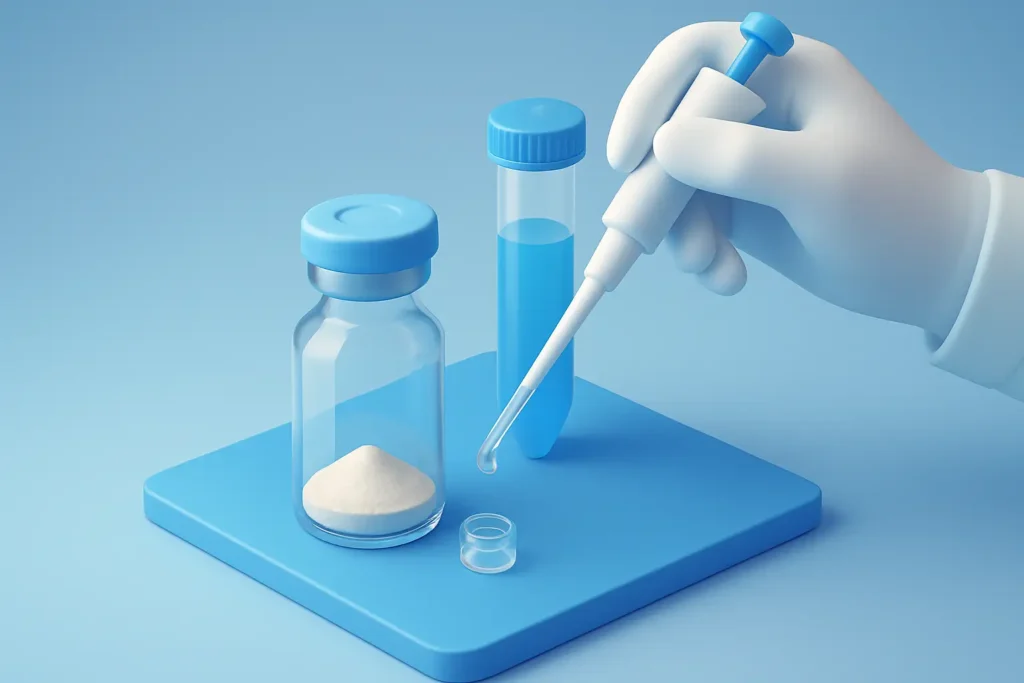
A lyophilised peptide can be analytically “perfect” on paper and still become the weak link in your workflow the moment it is reconstituted. Most avoidable variability in peptide work comes from a handful of controllable choices – diluent selection, aseptic handling, concentration planning, mixing technique, and storage discipline. If you care about reproducibility, you treat reconstitution as a controlled step, not an afterthought.
These reconstitution guidelines for research peptides are written for laboratory, analytical, and experimental research use only. Precision Peptides supplies non-consumable research materials; any reference here is strictly to controlled lab handling, not human or animal use.
What reconstitution actually changes (and why it matters)
Reconstitution is not just “adding water”. It changes the peptide’s chemical environment and exposes it to common degradative stressors: pH shifts, adsorption to plastics, oxidation, deamidation, and repeated temperature cycling. The most important practical point is that your initial solvent choice and final concentration can either reduce or amplify these risks.
Lyophilised material is generally more stable than solution. Once in solution, stability becomes time and condition dependent. That is why reconstitution should be planned backwards from your assay needs: required working concentrations, number of planned aliquots, how often you will thaw, and which analytical readouts are sensitive to trace contaminants or buffer components.
Choosing a diluent: water, bacteriostatic water, or buffer?
There is no universal “best” diluent. It depends on the peptide’s properties (charge, hydrophobicity, propensity to aggregate), the downstream method (LC-MS, ELISA, cell-free assays, surface binding), and how long you need the solution to remain fit for purpose.
Sterile water for injection-grade use is often chosen in research settings because it is simple and low background. For many peptides, sterile water is adequate for preparing a short-lived stock, especially if you aliquot immediately and store appropriately.
Bacteriostatic water (typically containing benzyl alcohol) can reduce microbial growth risk in multi-use vials. The trade-off is compatibility: preservatives may interfere with sensitive assays or surfaces and can complicate certain analytical baselines. If your method is particularly sensitive, you may prefer sterile water plus strict aseptic technique and single-use aliquots.
Buffered solutions can help where pH stability is critical or where peptides are unstable in unbuffered water. The trade-off is again analytical: buffers introduce ions and components that may affect chromatography, mass spectrometry, or binding interactions. If you select a buffer, keep it simple, document it precisely (composition and pH), and ensure it does not conflict with your detection method.
In practice, the most defensible approach is to pick the lowest-complexity diluent that keeps the peptide soluble and stable for your intended window of use.
Aseptic technique: treat the first puncture as the most important one
Contamination is not always obvious. A peptide stock can look clear and still carry bioburden that alters results over time. Reconstitution is also when particulates and fibres most commonly enter the sample.
Work in a clean area appropriate to your risk profile. Wipe vial stoppers with 70% IPA and allow them to dry. Use sterile, low-shed consumables. If you are preparing multiple vials, keep a disciplined sequence to avoid switching caps, needles, or labels.
Needle choice matters more than people assume: a blunt needle or poor technique can core the stopper, dropping rubber fragments into solution. Use suitable gauge needles, avoid excessive force, and visually inspect after the first draw.
Calculations that stay readable in a lab book
Reconstitution errors often come from doing the maths once, in a hurry, then trying to reverse-engineer what happened weeks later. Keep calculations explicit and standardised.
Start with the vial content (mass of peptide) and choose a target stock concentration that suits your workflow. Higher concentration is not automatically better. Very concentrated stocks can increase viscosity, promote aggregation, or make pipetting small volumes error-prone. Too dilute, and you are forced into repeated freeze-thaws or large storage volumes.
As a worked example:
If you have 10 mg lyophilised peptide and you want a 2 mg/mL stock, add 5 mL of diluent.
If you want the same 10 mg as a 1 mg/mL stock, add 10 mL.
If you plan to run repeated assays at 10 micrograms per run, it can be more practical to create a moderate stock (for stability) and then make fresh working dilutions on the day.
Document the final concentration in both mg/mL and (where molecular weight is known and relevant to your method) molarity. Conversions depend on molecular weight, so record the MW value used, not just the output.
Reconstitution technique: gentle, controlled, and patient
The goal is complete dissolution with minimal stress.
Introduce diluent down the inside wall of the vial rather than directly blasting the lyophilised cake. This reduces foaming and mechanical shear. After addition, let the vial stand briefly so the cake can hydrate evenly.
Mix by gentle swirling or slow inversion. Avoid vigorous shaking unless you are certain the peptide is resilient and your downstream method tolerates potential aggregation or foaming. Some peptides, especially those with hydrophobic segments, dissolve slowly. Time is often the cleanest solution.
If material appears to stick to the glass, resist the temptation to scrape. Instead, allow additional time, swirl intermittently, and maintain a controlled temperature. Slight warming (for example, holding at room temperature for a short period) can help dissolution, but uncontrolled heating can accelerate degradation. Keep any temperature step consistent and documented.
If the peptide still does not dissolve, that is a method decision point. Options in research settings can include adjusting pH, adding a small percentage of co-solvent, or changing buffer composition, but each change has assay implications. Any such adjustment should be justified by the peptide’s known behaviour and your analytical constraints.
Filtration: when it helps and when it harms
Sterile filtration can remove particulates and reduce microbial risk, but filtration is not neutral. Peptides can adsorb to filter membranes, and the loss can be non-trivial at low concentrations.
If you must filter, choose a membrane compatible with peptides (low protein binding) and pre-wet where appropriate. Measure recovery if quantitative accuracy matters. For many research workflows, it is cleaner to avoid filtration and rely on sterile diluent, aseptic technique, and aliquoting.
Aliquoting: the simplest way to protect stability
Freeze-thaw cycling is one of the most common causes of drift. Even when a peptide tolerates one or two cycles, repeated temperature swings increase the chance of aggregation and chemical change.
Aliquot immediately after dissolution into volumes that match your experimental cadence. Use low-binding tubes if adsorption is a concern, particularly for low-concentration working stocks. Label aliquots with peptide ID, concentration, diluent, date, and operator initials. If your lab uses sample IDs or QR labels, apply them at this stage rather than later.
Storage and handling: stop making the freezer do the work
Storage conditions are only useful if they are consistent.
For short-term use, refrigerated storage may be sufficient, but “short-term” depends on the peptide and the assay tolerance. For longer storage, frozen aliquots are typically used in research labs. The most important operational point is to avoid leaving aliquots at room temperature on benches for extended periods during busy runs. Build the handling into your method: remove one aliquot, thaw under controlled conditions, use it, and discard or clearly mark it as “opened” if it will be reused under an approved stability window.
Minimise exposure to light if the peptide is light-sensitive, and minimise headspace oxygen exposure for oxidation-prone sequences by using appropriate vial sizes and limiting repeated opening.
Documentation: make your reconstitution defensible
If results matter, documentation is not admin. It is part of quality control.
Record the lot or batch identifier, the diluent identity (including buffer composition and pH if applicable), the exact volume added, the final concentration, and the date/time of reconstitution. If you used a particular grade of water or bacteriostatic water, record that as well. Note any deviations: extended dissolution time, unusual appearance, or need for modified solvent.
This is also where supplier documentation supports your workflow. If you are selecting a vendor, prioritise those providing independent third-party analytical testing and certificates of analysis, because it allows you to trace identity and purity alongside your own handling records. Precision-focused buyers typically keep the CoA with the batch record so that any anomaly investigation has a complete chain of information.
If you require measured-quantity, research-only materials with verification documentation and discreet, tracked UK delivery, you can source them from Precision Peptides.
Common failure modes and how to avoid them
“Clear” does not always mean “correct”. A few patterns show up repeatedly in troubleshooting.
Unexpected loss of potency can come from adsorption to standard plasticware, especially at low concentrations. The fix is often as mundane as switching to low-binding tubes, increasing stock concentration within reason, or reducing the time a diluted peptide sits in a tube before use.
Poor run-to-run reproducibility often traces back to inconsistent thawing, partial mixing, or topping up volumes “by eye”. Controlled aliquots and explicit volumes reduce this.
Visible particles can be undissolved peptide, precipitate from incompatible buffer conditions, or stopper coring debris. The response depends on the cause. If you suspect coring, review technique and needle choice. If you suspect precipitation, reassess pH and ionic strength rather than simply shaking harder.
Finally, microbial contamination is more likely when multi-dose handling is casual. If you must access a vial repeatedly, bacteriostatic diluent may help, but it should be a conscious method choice with awareness of assay compatibility.
A good reconstitution is boring. The most useful closing thought is this: plan the solvent, concentration, and aliquot strategy before you open the vial, and your peptide will behave like a controlled research material – not a variable you spend the next month trying to explain.