
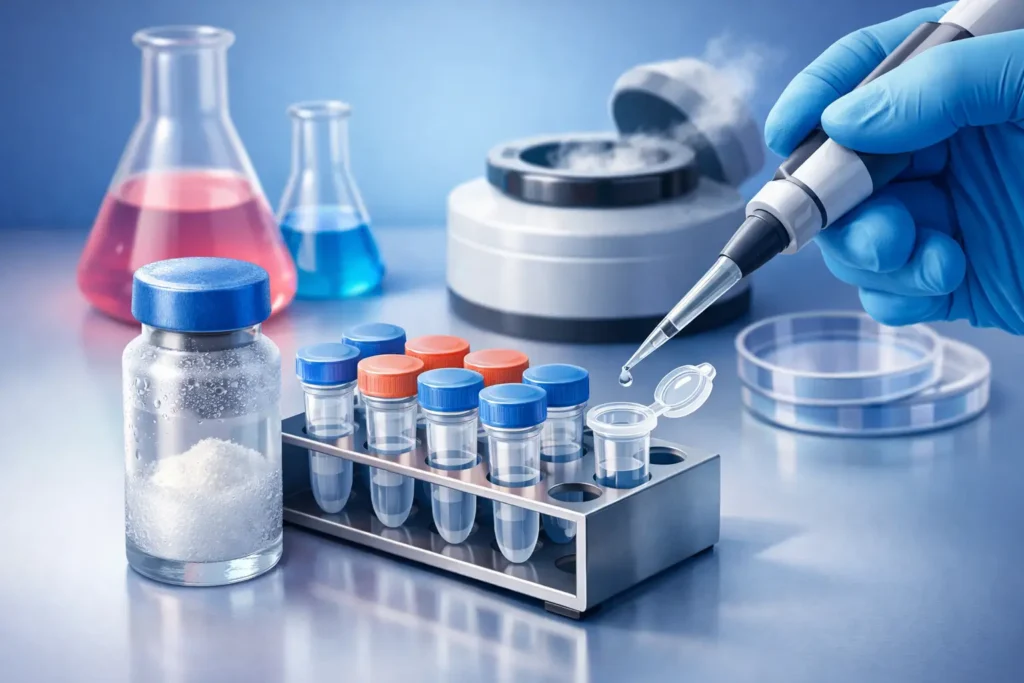
A peptide can be analytically clean at receipt and still become the weak point in your workflow within minutes of poor handling. Most aliquoting errors are not dramatic contamination events. They are small, cumulative losses – moisture uptake, repeated warming, adsorption to plastics, inconsistent reconstitution, or avoidable exposure to light and room air. If you are assessing how to handle peptides during aliquoting, the goal is simple: preserve identity, concentration accuracy and reproducibility from the first vial to the final stored fraction.
For research teams, aliquoting is not a routine packing exercise. It is a control point. Done properly, it limits freeze-thaw stress, reduces waste, supports batch consistency and makes downstream interpretation more defensible. Done carelessly, it introduces variability that no certificate of analysis can correct after the fact.
Why aliquoting matters more than most labs assume
Peptides are not one uniform class of material. Stability depends on sequence, length, terminal modifications, hygroscopicity, solubility profile and sensitivity to temperature, oxidation or light. Some compounds tolerate straightforward handling. Others lose integrity quickly if reconstituted improperly or held too long on the bench.
That is why aliquoting should be planned around the specific research use case rather than treated as a standard decanting step. A peptide intended for repeated analytical work over several weeks may need very different aliquot volumes from a material being prepared for a single short study. Smaller aliquots reduce repeat exposure, but if they are too small you may increase transfer error and surface loss. Larger aliquots are easier to handle, but they expose more material each time the vial is reopened. The right balance depends on expected use frequency, concentration requirements and storage conditions.
How to handle peptides during aliquoting without compromising quality
The first rule is to organise everything before the source vial is opened. Labels, low-binding tubes, calibrated pipettes, suitable tips, solvent or diluent, clean gloves and storage containers should all be ready in advance. Open handling time matters. The longer a peptide remains exposed to ambient conditions, the more opportunity there is for moisture uptake or degradation.
Work in a clean, controlled environment with a documented process. For laboratories with stricter contamination controls, that may mean a validated clean bench or cabinet aligned with internal SOPs. For smaller research settings, it still means minimising airflow disturbance, avoiding crowded benches and keeping handling disciplined. Aliquoting is not the step to improvise.
Temperature control also deserves more care than it often gets. If a peptide has been cold stored, do not repeatedly move it between chilled and ambient conditions without a plan. Allowing a sealed vial to equilibrate appropriately before opening can reduce condensation risk. Opening a cold container too soon can introduce moisture directly into the material, which is particularly unhelpful for hygroscopic compounds.
Reconstitution should follow verified product guidance where available. Some peptides dissolve readily in bacteriostatic water or another suitable research diluent, while others may require a staged approach depending on their chemistry. Forceful mixing is rarely ideal. Gentle swirling is usually preferable to aggressive shaking, which can promote foaming or unnecessary stress. If a peptide is difficult to dissolve, patience and controlled technique are better than repeated harsh agitation.
Choose aliquot size based on use, not convenience
A common mistake is choosing aliquot volumes that feel tidy rather than useful. The practical question is how much material will be needed per session, with a margin that avoids repeated micro-withdrawals from the same tube. If a lab expects ten separate experimental runs, ten well-planned aliquots are usually better than two larger fractions that must be reopened repeatedly.
This matters because every thaw or reopening event increases risk. Even if gross degradation does not occur, concentration drift and handling variability become more likely over time. For sensitive workflows, a single-use aliquot model is often the cleanest option. It can seem more labour-intensive up front, but it usually saves time and preserves consistency later.
There is, however, a trade-off. Very small aliquots can be disproportionately affected by adsorption to tube walls or pipette tips, especially at low concentrations. Where material is limited, the most defensible approach is often to validate a practical minimum aliquot volume within your own workflow rather than defaulting to the smallest possible fraction.
Containers, pipettes and surfaces can change your result
Not all plastics behave the same way with peptides. Adsorption losses can become significant, particularly for hydrophobic sequences or dilute solutions. Low-binding tubes and compatible pipette tips are often worth using when concentration accuracy matters. Standard consumables may be acceptable in some settings, but assuming equivalence across all plasticware is not a good laboratory habit.
Pipette calibration also matters more than many teams admit. Aliquoting is, at its core, a measurement task. If transfer volumes are inconsistent, your stored fractions are inconsistent before the experiment even begins. Use pipettes suited to the actual volume range, verify calibration on schedule and avoid stretching a device to the top or bottom of its workable limits.
Labelling should be immediate and precise. Each aliquot should be traceable to the source material, lot or batch identifier, concentration, diluent where relevant, date of preparation and storage condition. If your research environment requires chain-of-custody or inventory logging, this is the point to complete it properly. Reliance on memory is not a controlled method.
Storage discipline after aliquoting
Once aliquots are prepared, storage should be immediate and consistent. The correct temperature depends on the peptide and whether it is in lyophilised or reconstituted form. In many research settings, lyophilised material offers better long-term stability than solution form, but that does not mean every study can avoid reconstitution. If solution aliquots are required, ensure the planned storage period is realistic for the compound and matrix involved.
Avoid casual freezer access patterns. Frequent warming due to poor freezer organisation can shorten usable stability. Keep aliquots grouped, labelled clearly and positioned for fast retrieval. If one tube is needed, only one tube should be removed.
Light exposure can also be relevant. Some peptides are more light-sensitive than others, and repeated ambient exposure during bench work can be avoidable. Amber containers or protected storage may be sensible where supported by product-specific handling guidance.
Documentation is part of peptide handling
Reliable aliquoting is not only about physical technique. It is also about documentation that supports reproducibility. Record the original product details, any reconstitution steps, the exact diluent used, final concentrations, aliquot volumes, storage locations and any deviations from routine procedure. If a result later looks anomalous, these records often explain whether the issue originated in the biology, the assay or the handling.
This is one reason serious research buyers place value on independently third-party analytical testing and certificates of analysis. Verified purity and identity at supply stage provide a sound starting point, but the lab still carries responsibility for what happens after receipt. Precision in handling protects the value of that verified starting material.
Mistakes to avoid when aliquoting peptides
The most common problems are predictable. Opening cold vials before equilibration, using unsuitable diluents, preparing aliquots without a realistic use plan, relying on non-calibrated pipettes, leaving reconstituted solutions on the bench too long and failing to label immediately all create unnecessary risk.
Another frequent issue is assuming that all peptides respond the same way to the same procedure. They do not. Sequence-dependent behaviour can affect solubility, stability and surface interaction. Where manufacturer guidance, internal validation data or prior lab experience indicate a specific handling approach, use it. Standardisation is valuable, but only when it is technically justified.
A controlled approach protects downstream research
Aliquoting is a small step with outsized consequences. When the process is controlled, the benefits are practical and measurable – fewer freeze-thaw cycles, less waste, clearer documentation and more dependable experimental consistency. When it is rushed, the losses are often subtle enough to go unnoticed until data quality starts to drift.
For research use only materials, careful aliquoting is part of responsible laboratory handling, not an optional extra. Treat the step with the same discipline you expect from sourcing, testing and storage, and the rest of the workflow stands on firmer ground. A well-prepared aliquot does not draw attention to itself, which is exactly the point.