
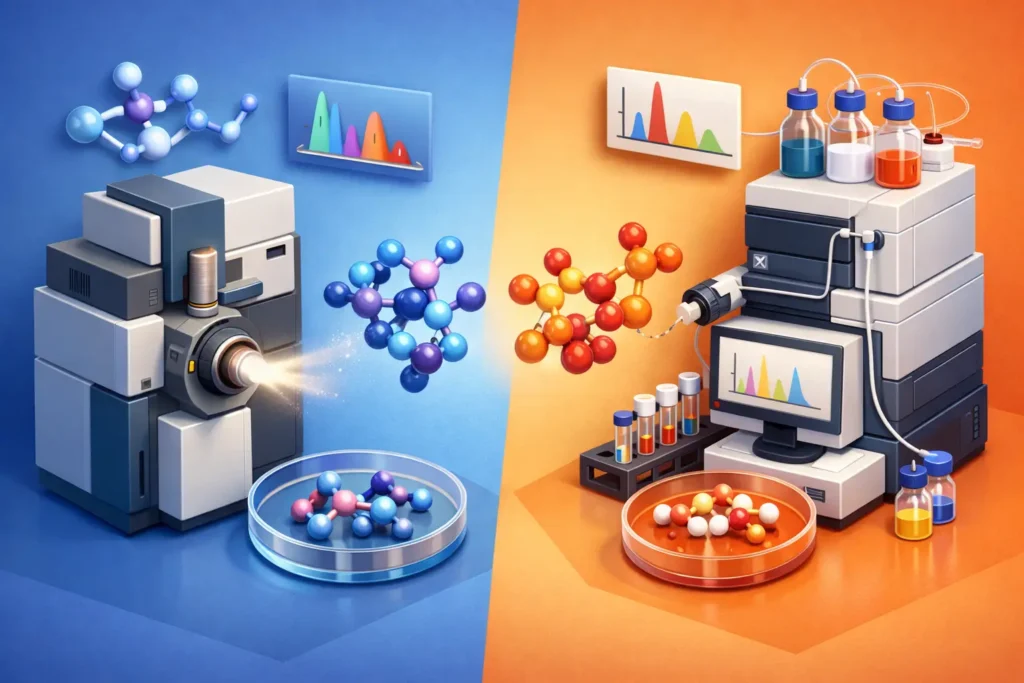
A peptide can arrive with a clean label, a stated purity, and a professional-looking certificate, yet the real question for any serious buyer is simpler – what exactly was verified, and by which method? That is where LC MS vs HPLC peptide verification becomes more than a technical distinction. It directly affects identity confirmation, impurity visibility, batch comparison, and the confidence you can place in research materials supplied for laboratory use only.
For research buyers working to controlled protocols, HPLC and LC MS are not interchangeable badges of quality. They answer different questions. One is primarily about separation and relative purity. The other adds molecular mass information that helps confirm whether the expected peptide is actually present. If your work depends on documented identity and reproducibility, understanding that difference matters before you place an order, not after a batch reaches the bench.
LC MS vs HPLC peptide verification – what each method tells you
HPLC, or high-performance liquid chromatography, separates components in a sample based on how they interact with the stationary phase and mobile phase. In practical terms, it shows whether a peptide preparation appears clean under the selected analytical conditions. A chromatogram with one dominant peak may indicate a high-purity sample, but that result is still conditional. It reflects how the material behaved in that specific method, on that column, with that solvent system, at that wavelength.
LC MS combines liquid chromatography with mass spectrometry. The LC stage separates the sample, while the MS stage measures mass-to-charge ratios for the eluting compounds. For peptide verification, that means you are not only seeing a peak at a given retention time. You are also checking whether that peak carries the expected molecular mass profile for the target sequence.
That difference is central. HPLC can suggest cleanliness. LC MS can support identity.
Why HPLC still matters in peptide quality control
HPLC remains a core analytical tool for peptide suppliers because it is efficient, established, and highly useful for routine purity assessment. When a supplier states a peptide is, for example, 98% pure by HPLC, that usually means the main chromatographic peak accounts for roughly 98% of the detected area under the stated method conditions.
For many research workflows, that is valuable information. It helps buyers compare lots, review consistency, and screen for obvious contamination or poor synthesis outcomes. HPLC is also well suited to release testing and batch-to-batch monitoring when the method is controlled and reproducible.
But HPLC has limits that serious buyers should not ignore. A single dominant peak does not automatically prove the peak is the correct peptide. Co-eluting impurities can be missed. Detection depends on the analytical set-up. Some impurities may absorb poorly at the monitoring wavelength, and structurally related compounds can sometimes behave similarly enough to appear deceptively clean.
This is why HPLC on its own is best understood as strong purity evidence, not complete identity proof.
Where HPLC is most useful
HPLC is especially useful when the main concern is relative purity under a validated or standardised method. It is also helpful for comparing one lot against another, reviewing degradation over time, and checking whether storage or handling may have altered the sample profile.
For buyers reviewing certificates of analysis, HPLC data becomes more meaningful when the documentation includes method conditions, retention information, and clearly presented chromatograms rather than a single purity claim without context.
Where LC MS adds value for peptide verification
LC MS gives the buyer another layer of analytical confidence because it links chromatographic behaviour with mass data. In peptide work, that matters because the expected molecular mass is one of the clearest markers that the synthesised product matches the intended target.
If a chromatographic peak is paired with the correct molecular ion pattern, the case for identity becomes much stronger. This is particularly useful for research peptides where sequence-specific confirmation matters and where close synthetic by-products may otherwise be difficult to distinguish through HPLC alone.
LC MS is also more informative when a sample contains multiple components. Even if two compounds sit close together chromatographically, mass data may help separate what the UV detector alone cannot. For buyers assessing supplier quality standards, LC MS indicates that identity verification was treated as a defined analytical requirement rather than an assumption.
That said, LC MS is not a magic stamp either. It confirms mass, not necessarily full sequence placement or every structural detail. Isomeric issues, certain modifications, or low-level impurities may still require additional analytical work depending on the sensitivity and purpose of the research. The right view is pragmatic: LC MS strengthens verification, but the exact adequacy depends on the application.
HPLC purity versus LC MS identity – not the same claim
One of the most common points of confusion in peptide purchasing is the assumption that a high HPLC purity figure automatically confirms the right compound. It does not. Purity and identity are related, but they are not the same analytical claim.
A sample can be highly pure in chromatographic terms while still being the wrong material if synthesis, labelling, or handling errors occurred. Equally, a sample can show the correct mass by LC MS while still containing impurities that reduce practical purity. Serious verification therefore asks two separate questions: is this the correct peptide, and how clean is the preparation?
The strongest supplier documentation answers both. That is why independent third-party analytical testing carries weight when it includes identity and purity evidence rather than a single headline percentage.
What research buyers should look for on a certificate of analysis
When comparing suppliers, a certificate of analysis should be read as a technical record, not a marketing insert. A useful certificate identifies the batch, the analyte, the test methods, and the results in a way that supports verification and auditability.
For peptide materials, HPLC results should ideally be accompanied by a chromatogram and a stated purity figure. LC MS results should indicate the observed mass and show alignment with the expected molecular weight. Batch number, test date, and where relevant the testing laboratory details also matter. Without those elements, a certificate may look formal while adding very little practical assurance.
For compliance-forward buyers, third-party testing is especially valuable because it reduces the risk of self-issued claims going unchallenged. Precision-focused suppliers understand that documentation is part of the product experience. It supports receiving checks, inventory control, and downstream experimental records.
Red flags worth noticing
A certificate that gives purity with no method named is weak. So is one that lists mass confirmation without actual reported values. The same applies where the batch number on the product does not clearly correspond to the batch on the analytical record.
If a supplier relies on general language such as tested for quality or verified in-house, that may not be enough for controlled research settings. Buyers who need repeatable materials should expect specificity.
Which method is better?
The short answer is that neither method replaces the other. If you are choosing between LC MS vs HPLC peptide verification, the better question is what level of evidence your workflow requires.
If your immediate need is a routine purity screen and lot comparison, HPLC may be sufficient provided the supplier is consistent and transparent. If identity confirmation is critical, LC MS should be part of the verification package. In many cases, the most credible standard is both: HPLC for purity assessment and LC MS for identity support.
This is particularly relevant for direct-to-customer research procurement, where the buyer may not have the time or internal capacity to re-verify every incoming lot immediately. In that setting, supplier discipline matters. Independent third-party analytical testing, clear certificates of analysis, controlled packaging and traceable batch records reduce avoidable uncertainty.
A practical buying standard for peptide verification
For UK research buyers, the most sensible purchasing position is straightforward. Do not treat HPLC and LC MS as competing claims. Treat them as complementary evidence. HPLC helps show how clean the material appears under defined conditions. LC MS helps show that the principal component aligns with the expected peptide mass.
That is a stronger basis for procurement decisions, especially when materials are intended strictly for laboratory, analytical, and experimental research use only. Not for human or animal consumption. The supplier that presents both forms of evidence clearly, preferably with independent third-party analytical testing and batch-specific documentation, is usually the supplier taking verification seriously.
When deadlines are tight, it is tempting to reduce quality review to price, stock status, and delivery speed. Those factors matter, but they should sit behind documented identity and purity, not ahead of them. A fast, tracked shipment is useful. A well-documented batch is what protects the work once the package is opened.