
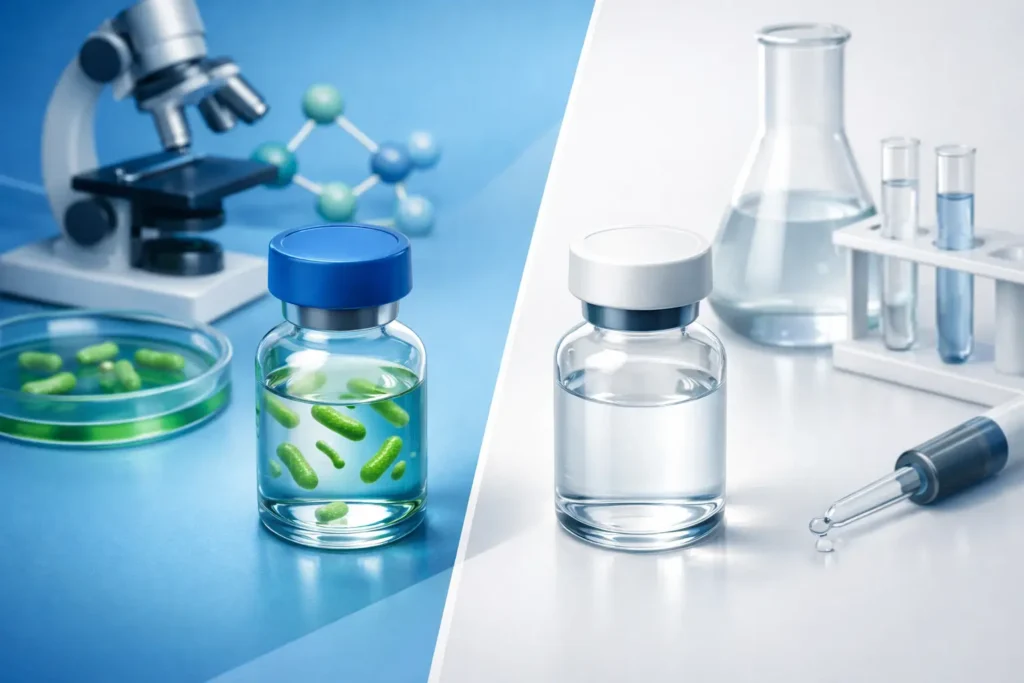
A small label difference can create a very real lab error. When researchers compare bacteriostatic water vs sterile water lab use, the decision is not about preference. It is about preservative content, protocol fit, storage expectations, repeat-access handling, and whether the chosen diluent supports controlled, documented research conditions.
In peptide and compound preparation workflows, this distinction matters early. If the wrong water type is selected at the reconstitution stage, the problem can carry forward into stability assumptions, sample handling, and reproducibility. For research settings focused on precision, the water used is part of the method, not an afterthought.
Bacteriostatic water vs sterile water lab use: the core difference
The simplest distinction is this: sterile water is sterile water for single-use or tightly controlled immediate-use applications, while bacteriostatic water contains a bacteriostatic preservative, typically 0.9% benzyl alcohol, intended to inhibit bacterial growth after initial entry.
That preservative changes the practical use case. In a laboratory workflow, bacteriostatic water may be selected where a vial is expected to be accessed more than once under controlled handling conditions. Sterile water, by contrast, is generally the cleaner choice when no preservative is wanted in the system and the material will be used promptly according to the protocol.
Neither option is universally better. The correct choice depends on the compound under investigation, the analytical objective, and the handling pattern expected once the container is opened.
Why the choice affects research quality
For serious research buyers, the issue is less about convenience and more about variable control. Benzyl alcohol can be acceptable in some workflows and undesirable in others. If a protocol is sensitive to excipient presence, adding a preservative may introduce a confounding factor. That is especially relevant in early-stage analytical work, compatibility checks, or any experiment where the fewest possible variables are preferred.
On the other hand, repeated vial access carries its own risk profile. If a researcher expects multiple withdrawals from a reconstituted material over a short period, bacteriostatic water can offer a practical contamination-control advantage when used correctly. It does not make handling casual or remove the need for aseptic technique, but it may support more controlled repeat access than preservative-free sterile water.
This is where documentation matters. The water selected should be recorded as part of the preparation method, alongside batch details, concentration calculations, storage conditions, and timing. Reproducibility depends on that level of precision.
When sterile water is the better fit
Sterile water is often preferred when the research aim requires a preservative-free environment. That includes compatibility-sensitive work, baseline testing, and protocols where benzyl alcohol could interfere with the compound, assay, or interpretation of results.
It is also the logical option when the prepared material is intended for immediate or near-immediate use within a controlled experiment. If there is no expectation of repeated vial entry, the preservative benefit may be irrelevant, while the addition of benzyl alcohol may be an unnecessary variable.
Researchers also choose sterile water when they want the diluent profile to remain as simple as possible. In analytical settings, simplicity is often a strength. Fewer additives mean fewer questions later when reviewing unexpected behaviour in the sample.
That said, sterile water demands disciplined handling. Once opened or once a preparation is made, the absence of a preservative means the window for controlled use may be narrower, depending on the material and the protocol.
When bacteriostatic water is the better fit
Bacteriostatic water is generally chosen for workflows that involve multiple withdrawals from the same vial under controlled laboratory conditions. The preservative is there to inhibit bacterial growth, which can make it more practical for certain repeat-access applications.
For some peptide reconstitution workflows, that can be operationally useful. A researcher may be preparing a measured-quantity material that will be sampled across several timepoints or used in a sequence of tightly managed experimental steps. In those cases, bacteriostatic water can align better with the workflow, provided the compound itself is compatible with the preservative.
That compatibility point should not be skipped. Not every research compound responds the same way to benzyl alcohol-containing diluents. Stability, solubility, and assay performance can vary. If the literature, internal validation, or prior lab data indicate preservative sensitivity, sterile water may still be the better choice even if repeat access would otherwise make bacteriostatic water attractive.
Handling and storage are part of the decision
Researchers sometimes frame this as a composition question only, but handling is equally important. The container closure, the expected number of entries, refrigeration requirements, light exposure, and total time between preparation and use all shape the right decision.
A preservative does not compensate for poor technique. If a vial stopper is repeatedly accessed without proper aseptic controls, contamination risk is still present. Likewise, sterile water is not inherently problematic if it is used in a protocol designed around single access or prompt use.
The better question is not simply, Which one lasts longer? It is, Which one fits the exact handling pattern of this experiment with the fewest avoidable risks? For a quality-assured lab, that is the more useful standard.
Bacteriostatic water vs sterile water lab use in peptide workflows
In peptide research, reconstitution decisions are often made quickly, but they should be made deliberately. Peptides can differ substantially in stability once reconstituted, and the selected water type becomes part of the compound environment from the first step.
If a peptide is being prepared for immediate analytical work, sterile water may offer the cleaner starting point. If the same peptide is expected to be accessed across a short controlled series of experiments, bacteriostatic water may better suit the handling plan. The deciding factor is not habit. It is compatibility plus workflow.
This is why serious buyers look beyond a simple product label. They want clear manufacturing standards, lot consistency, and documentation that supports internal verification. For research-use-only materials, reliable supply and traceable quality control are not marketing extras. They are part of the purchasing standard.
At Precision Peptides, that expectation is familiar. Research buyers want materials supported by independent third-party analytical testing, verified for purity and identity where applicable, and accompanied by clear documentation standards that fit real lab workflows.
What to check before selecting either option
Before ordering or using either water type, confirm four practical points. First, check whether the compound or protocol permits preservatives. Second, confirm whether the workflow involves single use or multiple withdrawals. Third, review storage and handling requirements after opening or reconstitution. Fourth, document the selected diluent in the method record so repeat work uses the same conditions.
Those checks sound basic, but they prevent common inconsistencies. Many avoidable issues in research prep come from assumptions made at the bench rather than decisions made from the protocol.
It also helps to distinguish between sterility and long-term suitability. Sterile water is sterile at the point of manufacture, but that does not mean it is intended for the same access pattern as bacteriostatic water. Bacteriostatic water contains a preservative, but that does not mean it is suitable for every compound. The label tells you what it is. The protocol tells you whether to use it.
The procurement angle researchers should not ignore
For UK laboratories and research-aligned buyers, supply reliability matters almost as much as composition. A delayed shipment can interrupt a tightly scheduled run. Poor packaging or weak lot documentation can create unnecessary review work. And if the supplier cannot clearly state standards, it becomes harder to defend consistency across experiments.
That is why procurement teams and experienced independent buyers often evaluate water products the same way they evaluate peptide stock: packaging integrity, controlled handling, traceability, and whether the supplier operates with a compliance-forward mindset. Secure, discreet, tracked delivery is useful, but only if the material arriving is supported by the right documentation and handled to a standard suitable for research use only.
In practice, the best choice comes from matching the water type to the experiment rather than forcing the experiment around a convenient stock item. That small decision at the start often protects far more valuable work downstream.
If your method depends on precision, treat the diluent with the same scrutiny as the compound itself. That is usually where better research starts.