
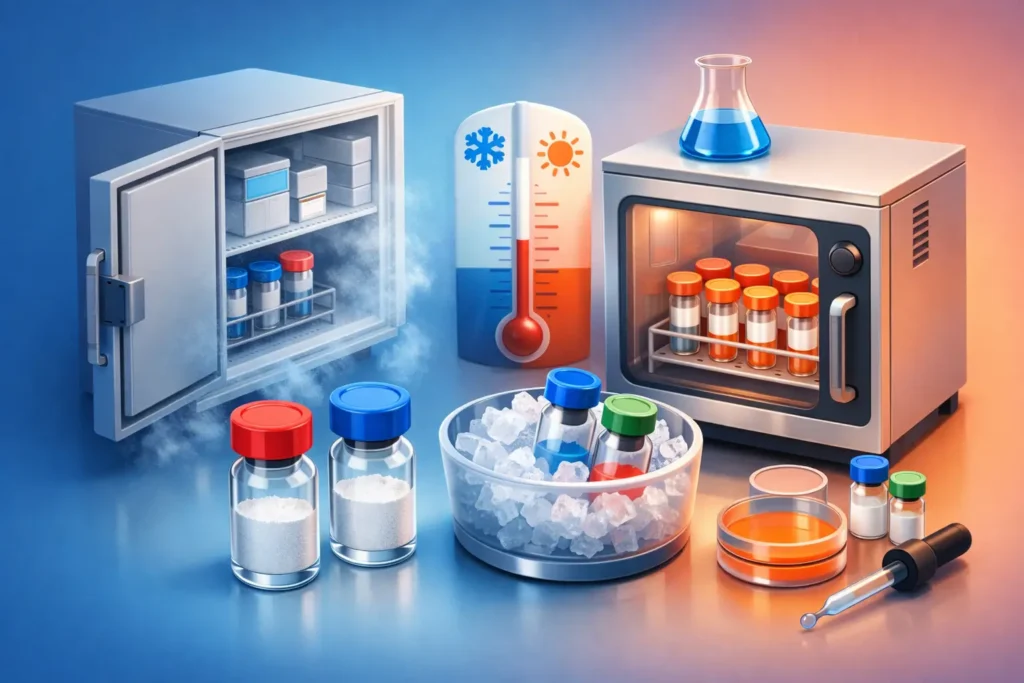
A peptide can leave the supplier verified for purity and identity, packed to controlled standards, and still become a variable in your workflow if storage conditions are set too casually. If you need to know how to set peptide storage temperatures, the right answer starts with the material state, the study timeline, and the level of handling control in your research environment.
For serious laboratory work, storage is not a housekeeping detail. Temperature affects stability, moisture exposure, degradation risk, freeze-thaw burden, and ultimately the reliability of downstream analytical or experimental results. That is why storage decisions should be documented with the same discipline applied to sourcing, batch verification, and sample tracking.
How to set peptide storage temperatures by material state
The first mistake many buyers make is using one temperature rule for every peptide. That is not a controlled approach. Storage temperature should be set according to whether the peptide is lyophilised, reconstituted, aliquoted for near-term work, or held for longer-term retention.
A lyophilised peptide typically tolerates storage better than a reconstituted one, provided it remains sealed, dry, and protected from repeated temperature changes. In many research settings, refrigerated or frozen storage is used for longer preservation of dry material, particularly when the project extends beyond immediate use. Once a peptide has been reconstituted, however, the risk profile changes. Water introduces more opportunity for hydrolysis, microbial contamination if handling is poor, and gradual degradation depending on sequence characteristics.
That is why the temperature you select should never be separated from the form the material is in. Dry stock and solution stock are different storage problems.
Lyophilised peptides
For short-term holding, some lyophilised peptides may remain acceptable under controlled refrigerated conditions, especially when they are unopened and protected from light and humidity. For longer-term storage, freezing is often the more conservative option. The key point is consistency. A dry peptide stored at a stable low temperature in a sealed container is generally in a stronger position than one moved repeatedly between bench, fridge, and freezer.
Reconstituted peptides
Reconstituted material usually requires colder and more tightly managed storage. Refrigeration may be suitable for very near-term use, but longer retention commonly calls for freezing in aliquots. Leaving a reconstituted peptide at fridge temperature for convenience can create avoidable instability, particularly if the research schedule stretches or the vial is opened multiple times.
The temperature itself is only part of the decision
Researchers often ask for a single number, but that can give a false sense of certainty. The practical question is not just whether a peptide should be kept at 4C, -20C, or lower. It is whether that temperature matches the peptide’s expected dwell time, handling frequency, and sensitivity.
If a sample will be used within days, refrigerated storage may be operationally sensible in some cases. If it is being retained for weeks or months, frozen storage is usually the more defensible choice. If the material is especially sensitive, or the protocol demands tighter stability control, deeper freezing may be justified. The trade-off is that colder storage is only helpful when the process around it is controlled. Poor aliquoting, door opening, condensation, and repeat thawing can undo the benefit.
In other words, a colder setpoint does not automatically mean better sample integrity. The system has to support it.
How to assess the right storage window
A reliable storage decision begins with three questions. First, is the peptide dry or in solution? Second, how soon will it be used? Third, will the same container be accessed multiple times?
If the peptide is dry and will be used promptly, a short, controlled hold may be reasonable depending on the product documentation. If the peptide is dry but intended for retained stock, frozen storage is often the safer route. If it is reconstituted and likely to be accessed repeatedly, single-use or low-use aliquots are usually preferable to one master vial that is thawed over and over again.
That last point matters more than many teams realise. Freeze-thaw cycling is a common source of preventable sample stress. It is rarely dramatic in the moment, but over time it can affect consistency. For research buyers who prioritise reproducibility, aliquoting is often one of the simplest improvements available.
Set temperatures around use patterns, not convenience
It is tempting to keep working material in the fridge because it is easier to reach. That may support speed, but not always control. Temperature policy should reflect expected use patterns. A sample used daily in the immediate term may justify a different arrangement from reserve stock held for repeat studies next month.
The strongest storage plans separate active-use material from archived or reserve material. That reduces unnecessary disturbance of the main stock and supports cleaner documentation.
Sequence and formulation can change the answer
Not all peptides behave the same way. Sequence length, amino acid composition, terminal modifications, and formulation conditions can influence stability. Some compounds are more sensitive to moisture, oxidation, or repeated warming than others. This is where generic internet advice becomes risky.
For that reason, product-specific documentation should always take priority. Where available, review the supplier’s handling guidance, batch information, and any supporting analytical documentation. Precision Peptides supports research buyers with independent third-party analytical testing and certificates of analysis, which helps strengthen verification workflows, but storage and handling still remain the responsibility of the research setting using the material.
If a project has low tolerance for variability, it is sensible to validate your internal storage approach rather than rely on assumption. That may include recording appearance, handling times, solution dates, and discard limits within the study file.
Practical controls that matter as much as temperature
A well-set freezer does not solve poor handling. Peptide storage works best when temperature is paired with dry conditions, light protection where relevant, clean reconstitution practice, and clear labelling.
Condensation is an overlooked issue. Removing a vial from frozen storage and opening it before it equilibrates can introduce moisture where you do not want it. Likewise, storing partially used material without firm closure or with inconsistent sealing increases avoidable exposure. These are small failures individually, but they accumulate.
Labelling should include at minimum the peptide name, batch or lot reference, concentration if reconstituted, solvent used, date of reconstitution, and designated storage condition. For regulated or tightly documented research environments, add operator initials and discard date. A sample with unclear storage history is not a reliable sample.
Refrigerators and freezers need verification too
Temperature setting is only meaningful if equipment performance is known. Domestic-style appliances or overloaded units can drift, recover slowly after opening, or show local hot and cold spots. For research use, periodic verification with calibrated monitoring is the more defensible standard.
This is particularly relevant for buyers ordering high-purity compounds for analytical work. The product may arrive under controlled packing and tracked delivery, but once received, environmental control passes to your facility. A good supplier reduces risk up to handover. Your storage process has to carry that standard forward.
A practical model for how to set peptide storage temperatures
Start with the manufacturer or supplier guidance for the specific research material. Then classify the sample as dry stock, working stock, or reconstituted aliquot. Set refrigerated storage only for clearly defined short-term use where documentation supports it. Use frozen storage for longer-term retention and for reconstituted material that will not be used immediately. Where repeated access is likely, aliquot first and store by intended use window.
Then document the rationale. This matters because consistency is part of quality control. If two technicians store the same peptide differently based on habit, your process is not controlled. A simple written rule, tied to material state and use period, usually prevents that drift.
Finally, avoid making storage decisions in isolation from the rest of the workflow. Receipt, unpacking, acclimatisation, reconstitution, aliquoting, and retrieval all affect sample condition. The best temperature policy is the one your team can apply consistently without improvisation.
For research use only, peptide storage should be treated as a stability decision, not a convenience decision. The closer your handling aligns with verified documentation, controlled temperatures, and disciplined sample management, the more confidence you can carry into the work that follows. A carefully stored sample does not guarantee a strong study, but a poorly stored one can undermine it before the first measurement is taken.