
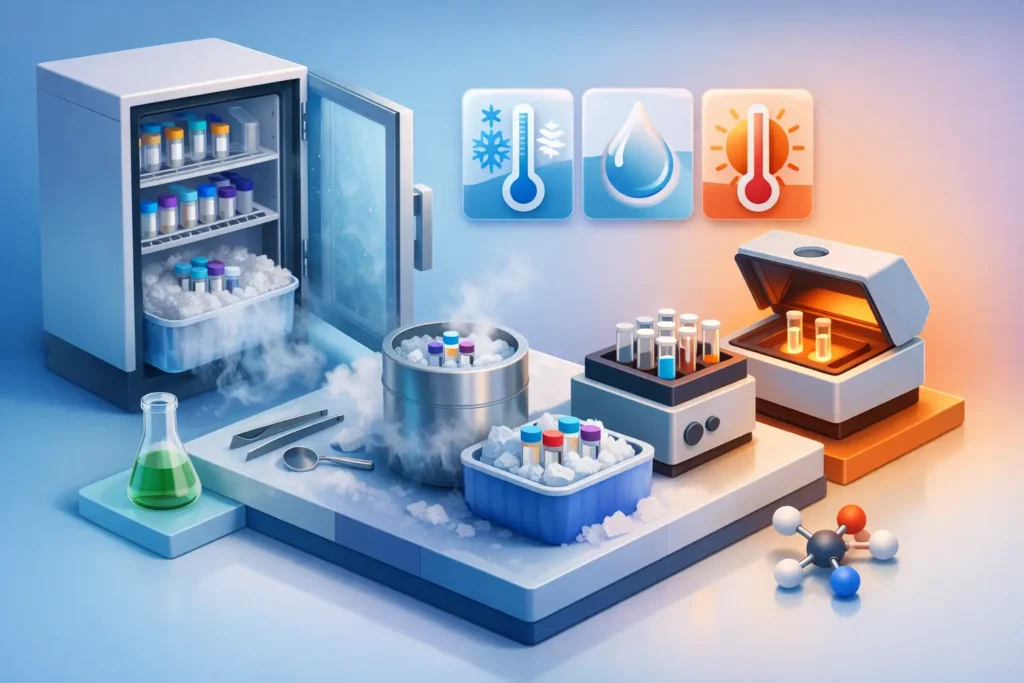
A peptide that arrives in-spec can still become a poor research material within days if storage is handled casually. When researchers ask about top peptide storage temperatures by compound type, they are usually trying to protect three things at once – identity, purity and reproducibility. The right answer depends on whether the compound is lyophilised or reconstituted, how often it will be accessed, and how sensitive the sequence is to moisture, oxidation and repeated temperature cycling.
For serious laboratory work, storage is not an afterthought. It is part of compound control. That means matching temperature to compound form, limiting unnecessary handling, and keeping documentation clear enough that any member of the team can verify what happened to a vial at each stage. All products discussed here are for laboratory, analytical and experimental research use only and not for human or animal consumption.
Why top peptide storage temperatures by compound type vary
There is no single storage temperature that suits every research peptide. A dry, lyophilised peptide often tolerates colder long-term storage very well because water activity is low and degradation pathways are slower. Once that same material is reconstituted, the risk profile changes. Hydrolysis, microbial contamination risk, adsorption to surfaces and loss from repeated thawing can all become more relevant than the original powder stability.
The compound itself matters too. Shorter and less chemically reactive sequences may remain comparatively stable under standard freezer conditions, while more delicate compounds may benefit from deeper freezing and tighter handling control. Peptides containing residues prone to oxidation or deamidation can require more conservative storage practices. Adjacent laboratory compounds, blends and tablet or capsule research formats may follow different rules again because excipients, moisture exposure and packaging format influence stability.
This is why suppliers that prioritise verification and controlled handling matter. Independent third-party analytical testing and certificates of analysis confirm what was released. Proper storage then helps ensure the material used in your study remains aligned with that verified profile for as long as reasonably possible.
Dry peptides – refrigerated or frozen storage?
For most lyophilised research peptides, short-term refrigerated storage at 2 to 8C can be acceptable if the vial will be used promptly and remains sealed, dry and protected from light where relevant. This is usually a practical option when a compound is expected to move into active research use soon after delivery. The key limitation is time. Refrigeration is generally more suited to short holding periods than archival storage.
For longer-term retention, freezer storage at around -20C is commonly preferred for lyophilised peptides. At this range, degradation pathways slow further, and the material is less exposed to temperature fluctuation than it would be in a frequently opened fridge. For many routine research compounds, this is the working default.
Where the peptide is known or suspected to be especially sensitive, deeper storage around -80C may be the more cautious choice. This is less about applying a universal rule and more about reducing risk where replacement cost, study criticality or sequence sensitivity justify stricter control. If your work depends on preserving a reference standard over an extended period, deeper freezing can be sensible even when -20C may be acceptable in theory.
The main trade-off is access. A vial stored at -80C but opened repeatedly may be handled less well in practice than one sensibly aliquoted and kept at -20C. Good storage is not only about the number on the freezer display. It is about minimising avoidable stress on the compound.
Reconstituted peptides need colder control and faster use
Once a peptide has been reconstituted, expectations should tighten. Refrigerated storage at 2 to 8C may be workable for very short-term use, but this should usually be measured in days rather than as an open-ended condition. Reconstituted material is inherently less stable than its lyophilised equivalent, and every access event increases exposure to contamination and temperature change.
For anything beyond immediate near-term work, storing reconstituted aliquots at -20C is often the safer baseline. This reduces the need to thaw and refreeze the same bulk solution, which is one of the most common avoidable causes of drift in sample quality. If the compound is particularly valuable, sensitive or intended for extended staged use, -80C aliquot storage may be justified.
The practical point is simple. Reconstitute only the amount you need for the planned run where possible. If a larger volume must be prepared, divide it into single-use or low-access aliquots before freezing. That approach is usually more effective than relying on one master vial and hoping careful technique will offset repeated thermal cycling.
Top peptide storage temperatures by compound type in practice
A workable framework starts by grouping compounds into operational categories rather than pretending every product behaves identically.
Lyophilised standard research peptides
For standard lyophilised peptides in active inventory, 2 to 8C can be reasonable for short-term storage if the vial stays sealed and dry. For medium to long-term storage, -20C is generally the more reliable choice. If the sequence is not unusually labile and handling is controlled, this often offers the right balance between stability and accessibility.
Lyophilised sensitive or high-value peptides
Where sequence chemistry suggests greater sensitivity, or where the material underpins a longer programme of work, -20C should be treated as the minimum serious storage condition and -80C considered for long-term retention. This is particularly relevant when replacing the batch would create comparability problems within an ongoing study.
Reconstituted working solutions
Use 2 to 8C only for very short-duration working storage. If the solution is not being used promptly, aliquot and move to -20C. For highly sensitive compounds, infrequently used standards or longer-term solution storage, -80C is often the better control point.
Peptide blends and adjacent compounds
Blends, amino preparations and non-lyophilised adjacent research materials should not be assumed to follow the same storage profile as single-entity peptides. Excipients, solvent systems and physical format alter risk. Tablets and capsules intended for research applications are often better managed in cool, dry, stable conditions rather than default freezer storage, unless product-specific documentation states otherwise. In these cases, the packaging format and manufacturer guidance matter more than broad peptide rules.
Temperature is only one part of compound protection
Researchers sometimes focus so heavily on freezer set points that they miss the wider handling picture. Moisture ingress can damage a lyophilised peptide regardless of nominal storage temperature. Light exposure may matter for certain compounds. Repeated opening of a vial in a humid environment can undermine an otherwise sound storage plan.
Cold storage also works best when containers are clearly labelled, tightly sealed and kept in a stable location within the unit rather than in high-traffic door compartments. Frost-free freezers can introduce more fluctuation than many teams realise. If a compound is especially important to study continuity, storing backup aliquots separately can reduce single-point failure risk.
Documentation matters just as much. Record receipt date, batch reference, storage condition, reconstitution solvent, aliquot date and number of freeze-thaw events where relevant. That level of control is consistent with quality-focused research workflows and makes it easier to investigate anomalies later.
Common mistakes that reduce peptide stability
The most common failure is treating all peptides as if they share one storage rule. The second is reconstituting too much material too early. After that comes repeated thawing of the same vial, poor sealing, and leaving compounds at room temperature during routine bench work longer than necessary.
Another issue is relying on memory instead of records. A vial without a clear reconstitution date or storage history quickly becomes a risk to data quality. For verified research materials, poor internal handling can erase the value of third-party analytical confirmation surprisingly quickly.
This is where operational discipline becomes commercially relevant too. Buyers comparing suppliers are not only buying a label claim. They are buying confidence that the compound arrived under controlled conditions and with documentation that supports proper downstream handling. That reliability mindset is central to how professional research buyers assess value.
How to choose the right storage condition for your lab
If the peptide is lyophilised and due to be used soon, refrigeration may be sufficient for the short term. If it is being retained for later use, move to freezer storage. If it has been reconstituted, think in terms of short refrigerated holding only, with aliquoted frozen storage for anything beyond immediate work. If the sequence is sensitive, the study is high-stakes, or the material is difficult to replace, deeper freezing deserves serious consideration.
There is no benefit in overcomplicating this. Match the storage temperature to the compound form, expected use window and sensitivity risk. Then support that decision with dry handling, minimal access and proper records. Precision Peptides serves research buyers who need exactly that kind of clarity – verified material, controlled fulfilment and guidance that respects reproducibility rather than guesswork.
The most useful storage rule is also the least glamorous: treat every peptide as if future data quality depends on what you do in the first ten minutes after receipt, because quite often it does.