
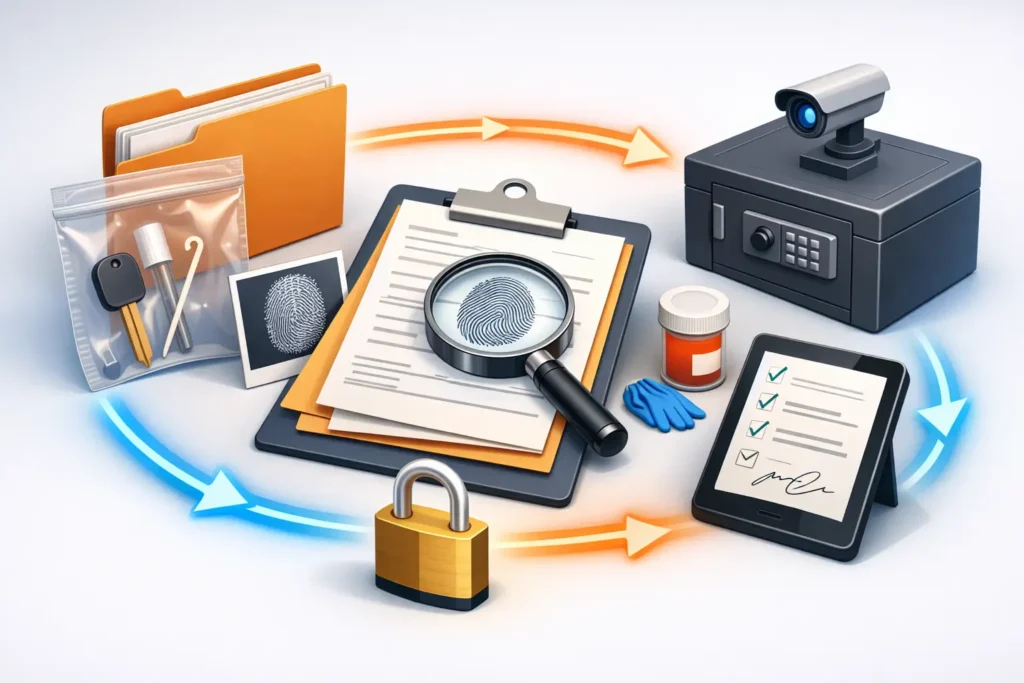
A vial can arrive with a certificate of analysis, intact packaging and a verified batch reference, then still become difficult to rely on if its handling record breaks down. Knowing how to document chain of custody gives research teams a clear, contemporaneous account of where a material has been, who controlled it and what happened at each handover. That record protects sample integrity, supports repeatable work and makes questions easier to answer before they become problems.
For research peptides and related laboratory compounds, chain of custody is not paperwork for paperwork’s sake. It is the practical connection between supplier documentation, receipt checks, storage controls and the observations generated during an experiment. Products must remain strictly for laboratory, analytical and experimental research use only. They are not for human or animal consumption.
What a chain of custody record should prove
A chain of custody record should allow an independent reviewer to reconstruct the material’s journey without relying on memory. At minimum, it should identify the item unambiguously, establish its starting point, record every transfer of control and show its final status.
The detail required depends on the work. A short internal assay involving a single analyst may need a straightforward controlled log. Work supporting a regulated quality system, external collaboration, publication, dispute resolution or formal investigation may require stricter sign-off, access controls and audit trails. The principle remains the same: each record must be attributable, legible, dated and difficult to alter without trace.
A useful record answers five practical questions: what was the material, where did it come from, who had it, where was it held, and what was done to it? If any answer is uncertain, the chain is incomplete.
Start the record before the package is opened
The strongest custody record begins at receipt, not when the material reaches the bench. Assign an internal sample or inventory identifier as soon as the shipment is accepted. That identifier should follow the material through storage, aliquoting, testing and disposal, while the supplier’s batch or lot number remains visible in the record.
At goods-in, record the delivery date and time, the receiving person, purchase order or order reference, supplier, product description, quantity, batch number and condition of the outer and inner packaging. Note the courier tracking reference where it is relevant to your laboratory’s procedures. If controlled-temperature packaging, seals or labels show an issue, document the observation immediately, take photographs where permitted by policy, and place the material in quarantine pending assessment.
The certificate of analysis should be filed against the internal identifier, alongside the product label and any relevant supplier documentation. A certificate of analysis supports identity and purity verification, but it does not evidence what happened after delivery. Your custody log provides that missing operational history.
Use one identifier that cannot be confused
Descriptive names alone are weak identifiers. Names can be shortened, repeated or transcribed incorrectly. Use a unique sample ID on the receipt record, storage location, working documents and any daughter containers created from the original item.
For example, an internal ID might combine the receipt date, material class and sequential number. The exact format matters less than consistency. Avoid reusing IDs, even after disposal. A retired identifier should remain permanently associated with its historical record.
When aliquots or sub-samples are prepared, create a parent-child relationship. The record for each daughter container should state its own ID, the parent ID, the preparer, date and time, quantity transferred, and any dilution medium or preparation step. This prevents a common gap: being able to identify an original vial but not the material actually used in the experiment.
Record every transfer, not only every experiment
A chain of custody entry is required whenever responsibility changes or the material moves to a different controlled location. This includes transfer from receiving to storage, collection from storage, movement to a laboratory area, transfer between authorised researchers, return to storage and disposal.
Each entry should capture the following information:
- Unique sample ID and, where useful, the supplier batch or lot number.
- Date and time of the transfer or handling event.
- Name and signature, initials or secure electronic identity of the person releasing the material and the person receiving it.
- From and to locations, recorded with enough specificity to find the material again.
- Quantity or container count, container condition and, where relevant, storage conditions.
- Purpose of transfer, such as analytical testing, aliquoting, controlled storage or disposal.
- Exceptions, observations or corrective actions, including damaged labels, temperature concerns or quantity discrepancies.
Do not treat a signature as a substitute for useful detail. “Transferred to lab” leaves too much open to interpretation. “Released from freezer B, rack 3, box 2 to analyst AB for LC-MS identity work, one sealed vial” is meaningful and verifiable.
Control storage and access records
Custody can be lost without a physical handover. An unlocked fridge, an unlabelled secondary container or a shared spreadsheet with unrestricted editing creates uncertainty about control. Store research materials in a defined location with access limited to authorised personnel, and document the location in a way that is practical for your facility.
For temperature-sensitive material, link the custody record to the applicable storage monitoring record. You do not need to copy every temperature reading into the chain of custody, but you should be able to show which monitored unit held the sample and whether an excursion review was required. If a deviation occurs, record the sample ID, time period, assessment, decision and authorising person.
Paper logs can work in small, disciplined environments, provided entries are made in permanent ink, corrections retain the original entry, and pages are controlled. Electronic systems can improve searchability, permissions and audit history, but only if user accounts are individual and changes are traceable. A shared file with editable cells and no version control is not a reliable custody system.
Document exceptions without trying to tidy them away
The point of a chain of custody is accuracy, not the appearance of perfection. If a seal is compromised, a sample cannot be located temporarily, a handover was missed or a storage excursion is suspected, record the facts as soon as they are known. State what was observed, who was informed, what immediate controls were applied and how the impact was assessed.
Avoid backdating entries or silently correcting a record. In a paper log, strike through an error with a single line, enter the corrected information, then date and initial the amendment. In an electronic system, use an audit-trailed correction process. Where the original record is unclear, add a clarification that identifies the reason and the person making it.
For significant discrepancies, quarantine the material until an authorised reviewer determines whether it remains suitable for the intended research use. The decision should be based on documented evidence, not assumptions. Depending on the issue, that may mean checking packaging, reviewing storage data, comparing quantities, consulting the relevant method or arranging further analytical verification.
Make the log fit the workflow
Overly complicated forms encourage late or incomplete entries. A practical chain of custody form should be easy to complete at the point of work, whether on paper or in a controlled digital system. Build the essential fields into a single repeatable workflow and train personnel on when an entry is required.
Review records periodically rather than waiting for an audit or failed result. A supervisor or quality lead can check whether sample IDs match labels, transfers are chronological, locations are current and all aliquots can be traced back to a parent item. Small checks often identify weak habits early, such as missing times, inconsistent initials or informal transfers between colleagues.
Supplier quality documentation also belongs in this workflow. Precision Peptides provides certificates of analysis to support research verification, but receiving laboratories remain responsible for confirming receipt, storage, handling and use under their own procedures. Third-party analytical documentation and an unbroken internal custody trail serve different purposes, and together they provide a more defensible record.
Retain records for as long as the work requires
Set a retention period that reflects the nature of the project, institutional requirements, contractual commitments and any applicable quality framework. Keep the custody record together with the receipt record, certificate of analysis, storage-monitoring references, analytical raw data, deviation reports and disposal documentation. A record is far more useful when the evidence around it can be retrieved quickly.
At disposal, document the remaining quantity where feasible, disposal method, date, responsible person and any required witness or waste reference. This closes the material’s lifecycle and prevents an old inventory entry from being mistaken for available stock.
A well-maintained chain of custody should feel almost unremarkable during routine work: every vial identifiable, every movement accounted for and every exception visible. That quiet discipline gives researchers something more valuable than a complete form – confidence that the material behind the result is the material they believe it to be.