
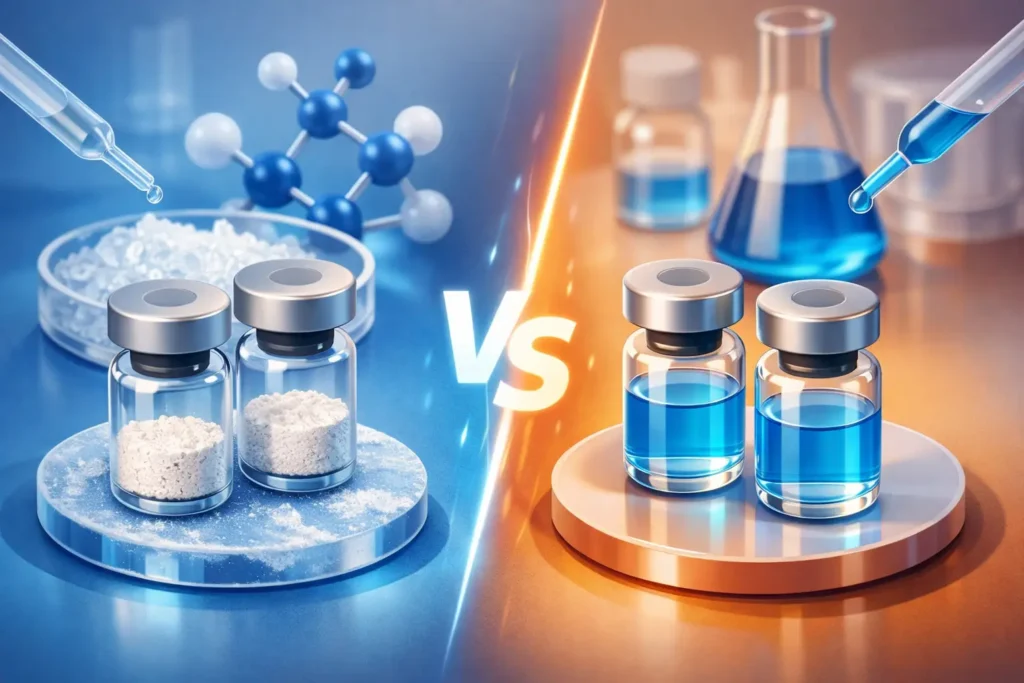
A vial format can determine whether a promising experiment starts with a controlled preparation or an avoidable source of variability. When comparing lyophilised peptides vs solution vials for lab workflows, the central question is not which format is universally better. It is which format provides the most reliable fit for the material, method, storage capacity and repeat-use pattern in your laboratory.
For research buyers, this decision should begin with verification rather than convenience. Confirm peptide identity, stated purity, batch details and the accompanying certificate of analysis before considering vial format. Both lyophilised material and pre-prepared solutions can support serious analytical and experimental work, but they place different controls in the hands of the laboratory.
Lyophilised peptides vs solution vials: the operational difference
Lyophilised peptides are supplied as dried material, commonly appearing as a cake, powder or thin film within a sealed vial. Before use, the laboratory reconstitutes the material with an appropriate solvent according to its validated protocol. This adds a preparation step, but it also allows the researcher to select solvent, concentration and aliquot size around the study design.
Solution vials contain material already dissolved in a stated vehicle at a stated concentration. They can reduce preparation time and may be appropriate where a method requires a ready-to-use format. However, the solution’s stability is tied to the chosen vehicle, concentration, storage conditions and time from manufacture or reconstitution. The laboratory has less flexibility to alter these variables without creating a new preparation.
Neither form removes the need for controlled handling. A documented chain of custody, defined storage conditions and a clear record of each preparation remain essential. Products supplied by Precision Peptides are strictly for laboratory, analytical and experimental research use only. They are not for human or animal consumption.
Stability is usually the deciding factor
For many peptides, dry storage provides a practical advantage because removing bulk water can reduce hydrolytic degradation pathways. Lyophilisation is not a guarantee of indefinite stability, nor does it make every peptide equally tolerant of poor storage. Temperature, light exposure, container closure, moisture ingress and repeated handling still matter. The supplier’s product documentation and storage guidance should set the baseline.
A solution vial begins with an additional variable: the peptide is already in contact with its solvent. Depending on the compound and vehicle, this may increase sensitivity to oxidation, aggregation, adsorption to surfaces or chemical degradation over time. A ready-made solution may remain entirely suitable within its defined storage window, but that window needs to be understood and built into the workflow rather than assumed.
This distinction matters most where studies run over several weeks, where only small quantities are used per session, or where repeat testing is expected. In those cases, a lyophilised vial can allow the laboratory to reconstitute only the amount required and retain the unopened dry material under the specified conditions. For rapid, short-duration work with a validated solution format, the convenience of a solution vial may justify the trade-off.
Reconstitution creates control, and responsibility
The advantage of a lyophilised vial is flexibility. The laboratory can prepare a concentration that suits instrument response, assay range or sample-volume constraints. It can also use a solvent system that has been assessed for compatibility with the peptide and the method.
That flexibility requires disciplined execution. Inconsistent solvent volume, incomplete dissolution, unsuitable mixing, contamination or unclear labelling can compromise reproducibility before any analytical work begins. Reconstitution should therefore be treated as a controlled preparation event, not a minor administrative step.
A sound record should identify the source vial and batch, solvent identity, solvent lot where relevant, volume added, target concentration, preparer, date and time, and assigned storage conditions. If the working solution is divided into smaller portions, each aliquot should retain an unambiguous link to the original material and preparation record.
Workflow speed versus method flexibility
Solution vials can be useful when throughput is the immediate priority. A laboratory receiving a verified material at a known concentration may be able to move directly into a defined dilution or analytical sequence. This can reduce hands-on preparation, shorten training requirements and limit opportunities for volumetric error.
The same convenience can become restrictive when a project changes direction. If the supplied concentration is poorly matched to the required working range, the laboratory may need multiple serial dilutions or may consume more material than necessary. If the solvent is unsuitable for a revised assay, there is limited scope to change it without a fresh preparation. It also becomes harder to separate a small portion for an exploratory method without repeatedly accessing the primary solution.
Lyophilised material generally suits laboratories that need to adapt concentrations across methods or retain material for staged studies. It is particularly practical where a protocol benefits from single-use or limited-use aliquots. Preparing smaller, clearly labelled aliquots after reconstitution can reduce repeated freeze-thaw exposure and minimise avoidable handling of the main preparation.
The appropriate approach depends on the validated method. A vial should never be selected solely because it looks simpler on a purchasing page. Consider how often the material will be accessed, the precision required at low volumes, the available equipment and whether your team has a documented reconstitution procedure.
Documentation and traceability should not change with the format
A high-purity peptide is only as useful as the evidence supporting its identity and handling history. Whether you select dry material or a solution, review the certificate of analysis, confirm the batch identifier against the vial label and retain those records with the study file. Independent third-party analytical testing and transparent documentation help research teams establish a reliable starting point, but the laboratory must maintain that traceability after receipt.
For a solution vial, record the received concentration, vehicle, stated storage requirements, opening date and any subsequent dilution steps. For lyophilised material, document the vial condition on receipt, reconstitution parameters and the identity of every resulting aliquot. In both cases, record deviations immediately. A vial briefly left outside its specified storage range, an unexplained concentration discrepancy or a missing label is information that may affect interpretation later.
This is especially relevant when comparing results between runs, analysts or sites. Apparent differences in peptide performance may reflect preparation history rather than the research question. A traceable format and a controlled workflow make it easier to investigate that possibility.
How to choose the right vial format
Start with the planned use, not the preferred format. Lyophilised peptides are often the stronger choice where long-term inventory management, custom concentration preparation, staged experimentation or aliquoting are priorities. They are also useful when the laboratory wants direct control over solvent selection, provided compatibility has been assessed.
Solution vials may be a sensible choice where the solvent and concentration already align with a validated method, the anticipated use window is short, and immediate readiness has real operational value. They can simplify routine work, but only when the team can preserve the stated storage conditions from delivery through to use.
Before ordering, ask four practical questions. Will the full vial be used in one session or across several sessions? Does the method require a specific solvent, buffer or concentration? Can the laboratory accurately prepare and verify the required dilution range? Is there sufficient temperature-controlled storage for unopened material, prepared solutions and aliquots?
The answers often make the decision clear. A small project with immediate use may favour a solution. A programme involving repeat sampling, several assay formats or uncertain volume requirements will often benefit from the control offered by lyophilised material.
Controls that protect reproducibility
Format selection is only one part of a dependable peptide workflow. On receipt, inspect packaging and labels, check the batch against supplied documentation and transfer material promptly to the specified storage environment. Maintain a clear receiving log and avoid treating product labels as a substitute for laboratory records.
For reconstituted material, use appropriate calibrated equipment and an established procedure. Do not rely on visual appearance alone to confirm dissolution or concentration. Where the method demands it, use suitable analytical checks to verify the prepared sample before committing valuable experimental time.
Keep access controlled and labelling specific. “Peptide solution” is not an adequate label for a shared cold-storage environment. Include the material identifier, concentration, solvent or vehicle, preparation date, storage requirement and, where applicable, expiry or review date. These small controls reduce the risk of mix-ups that can undermine otherwise careful work.
The most useful vial is the one that gives your laboratory a documented, repeatable path from receipt to result. Choose the format that fits the method, preserve the evidence around every preparation, and treat verified material with the same level of control expected from the experiment it supports.