
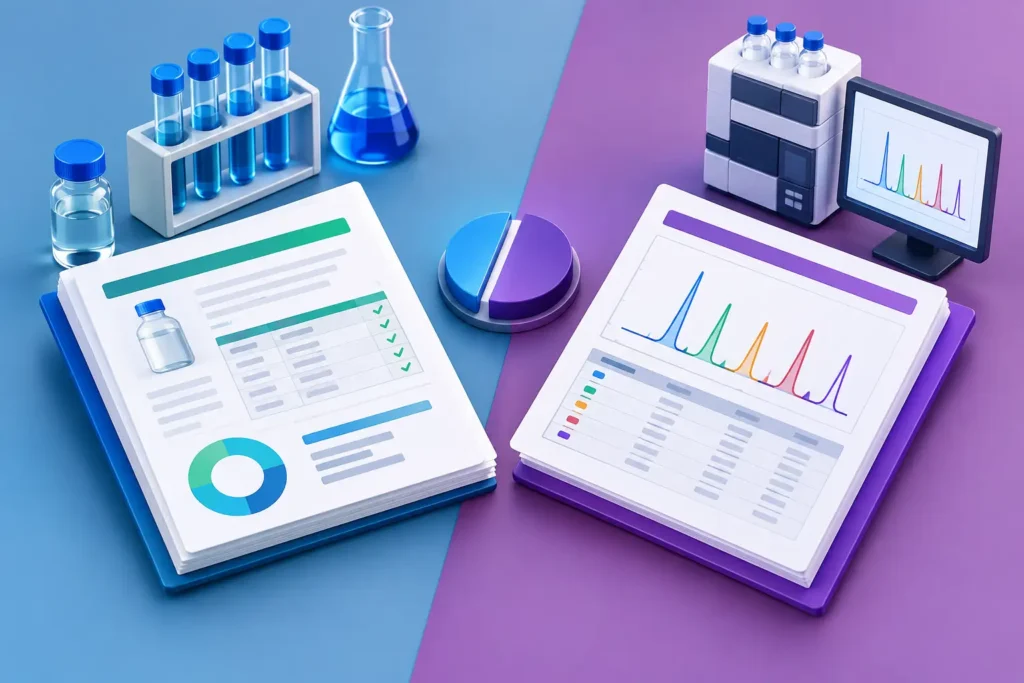
A reported purity figure can look decisive on a product page, yet its value depends on the evidence behind it. When assessing CoA versus chromatogram reports, researchers are not choosing between two interchangeable documents. They are examining two different layers of analytical assurance: a controlled summary of batch results and the underlying instrumental output that helps put those results into context.
For research peptides and related laboratory compounds, both documents can support supplier qualification, incoming-material checks and reproducible experimental planning. Neither, however, removes the need for appropriate methods, controlled handling and an assessment that matches the intended research use.
What a Certificate of Analysis tells you
A Certificate of Analysis, usually shortened to CoA, is a batch-specific document that records whether a material met stated release criteria. In a well-prepared CoA, the product name, batch or lot number, test method, reported result, acceptance specification, test date and authorising laboratory details should be clear. Depending on the material and supplier, it may also state the net content, appearance, storage conditions and identity result.
Its practical strength is efficiency. A CoA turns the relevant release information into a document that can be reviewed, filed and matched to the label on the received item. For a buyer comparing sources of a research peptide, it provides a direct answer to several initial questions: was this batch tested, what was the stated purity result, and did the result meet the supplier’s specification?
That does not mean every CoA carries the same evidential weight. A document with no batch reference, no method named, a generic issue date, or a result that cannot be linked to the supplied material should be treated cautiously. Likewise, a purity statement alone does not establish every aspect of quality. Purity, identity, quantity and microbiological status are separate attributes, and the relevant testing depends on the material and intended analytical work.
A CoA is a release record, not a complete laboratory notebook
The CoA is designed to report a conclusion, not every raw observation made during analysis. It may state that HPLC purity was 99% or greater, but it will not necessarily show peak integration settings, detector wavelength, column chemistry, gradient programme, sample preparation, reference standard details or system-suitability data.
For routine procurement, that concise format is often appropriate. For a method transfer, disputed result, high-consequence study or deeper vendor audit, the supporting data may matter just as much as the summary. This is where chromatogram reports become useful.
What a chromatogram report adds
A chromatogram is the instrument-generated trace produced during chromatographic analysis, commonly HPLC or UPLC. It displays detector response over retention time. Peaks represent components detected under the chosen analytical conditions, while the integrated peak areas are commonly used to estimate relative composition.
A chromatogram report generally contains more than the graph itself. It may include the sample identifier, run date, method name, retention time, peak table, area percentage, integration parameters and, in stronger documentation packages, system-suitability results and reference comparison information. These details allow a technically qualified reviewer to ask more precise questions about the reported purity value.
For example, a dominant main peak may support the claim that one component accounts for most of the observed signal under that method. Smaller peaks may indicate related substances, synthesis by-products, degradation products, residual impurities or other components. Their presence is not automatically disqualifying. The key questions are whether they are understood, whether they fall within the stated specification and whether the method can detect the impurity profile that is relevant to the research application.
A chromatogram is therefore informative, but it is not self-interpreting. A clean-looking trace does not, by itself, prove identity or absolute purity. An impurity that does not absorb effectively at the selected wavelength may be underrepresented. Co-eluting compounds may appear as a single peak. The reported result also depends on method conditions and integration choices.
Chromatography supports identity, but may not settle it alone
Retention time can be compared with a reference under the same conditions, making chromatography useful evidence for identity. However, retention time is not a unique molecular fingerprint. Two compounds can behave similarly on a given column and method.
For peptide identity, mass spectrometry is often particularly valuable because it assesses molecular mass. Depending on the analytical requirement, researchers may look for a coherent package of evidence: chromatographic purity, mass confirmation and a batch-linked CoA. More specialised work may require additional characterisation, particularly where sequence confirmation, counter-ion content or residual solvents affect the study design.
CoA versus chromatogram reports: which should come first?
For most purchasing decisions, begin with the CoA. It should provide the batch-level overview needed to verify that the supplied material has been assessed against a stated specification. If it cannot be matched to the vial, packaging or fulfilment record, the document has limited practical value regardless of how polished it looks.
Then consider the chromatogram report when the research risk warrants additional scrutiny. It is especially useful when comparing suppliers, qualifying a new material, investigating an unexpected experimental result, or checking whether a purity claim appears consistent with the analytical trace. A chromatogram adds transparency, but it should be associated with the same batch and, ideally, accompanied by enough method information to be meaningfully reviewed.
The right level of documentation depends on the work. A preliminary analytical investigation may reasonably begin with a credible, batch-specific CoA and a stated test method. Work that informs critical decisions, method development or formal records should have a more demanding evidence threshold. In those settings, request the information needed for an independent laboratory to understand the result, rather than relying on a headline percentage.
How to assess a documentation package
A reliable review starts by matching identifiers. The product name, strength or quantity, lot number and document date should align with the material in hand. A CoA that refers only to a product family rather than an identifiable batch is not the same as batch-specific analytical evidence.
Next, read the result alongside the method and specification. “Purity: 99%” is incomplete unless the basis is clear. Is the result reported as HPLC area percentage? Which detection wavelength and method were used? What acceptance criterion applied? For peptides, the distinction matters because area normalisation is a useful chromatographic measure but does not automatically equal absolute mass purity.
Review identity evidence separately. A supplier may report identity by mass spectrometry, retention-time comparison or another method. Stronger documentation states the result rather than relying on a vague tick box. If molecular identity is central to the experiment, ask whether the evidence is sufficient for that specific purpose.
Finally, check provenance. Independent third-party analytical testing can reduce conflicts of interest and provide useful additional assurance, provided the testing laboratory, batch linkage and reported methods are clear. It is reasonable to ask whether a report is generated from the supplied batch rather than reused across multiple lots.
Common mistakes when reading purity documentation
The most frequent mistake is treating a high purity percentage as a universal quality verdict. A 99% chromatographic purity result may still leave questions about peptide identity, moisture, counter-ions, residual solvents, endotoxin or biological activity. Not every question matters in every study, but they should not be confused.
Another mistake is comparing results from different methods as if they were directly equivalent. Two suppliers may both state 98% purity while using different columns, gradients, wavelengths, integration rules or sample conditions. The figures can be useful screening information, yet the comparison is only as sound as the analytical context.
It is also unwise to reject a chromatogram simply because minor peaks are visible. Analytical methods are intended to reveal variation. The more useful assessment is whether those peaks are identified where necessary, controlled against a justified specification and compatible with the work being performed.
Documentation should support controlled research
At Precision Peptides, certificates of analysis and independent third-party analytical testing are intended to give research buyers a clearer basis for evaluating purity and identity. Documentation supports informed laboratory decisions, but it does not replace suitable storage, handling, method verification or the researcher’s own quality procedures.
All products must remain within their stated research-only purpose and are not for human or animal consumption. Where a project has stricter requirements, the appropriate course is to define the analytical attributes needed before ordering and verify that the available batch documentation can support them. The best document is not the one with the most impressive headline number; it is the one that can be traced, understood and used confidently within a controlled research workflow.