
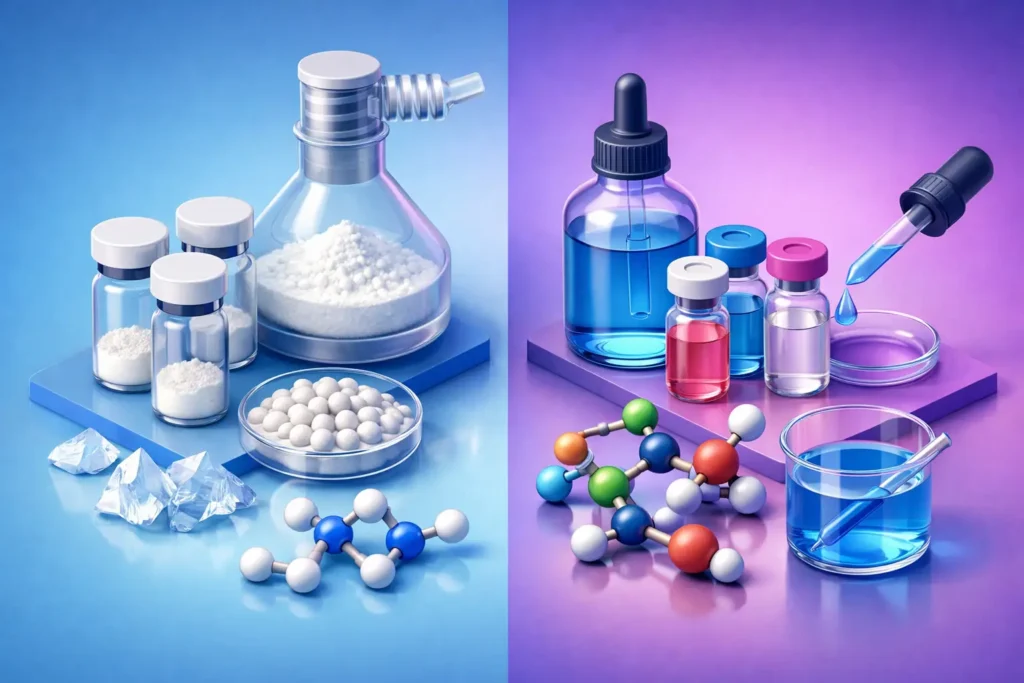
A vial arriving as a dry, measured powder and one arriving as a prepared liquid may represent the same nominal compound, yet they create very different control points in a research workflow. When assessing lyophilised peptides vs liquid compounds, the practical question is not which format is universally superior. It is which format gives your laboratory the clearest route to verified identity, appropriate storage, traceable handling and reproducible experimental work.
For qualified research use, format is part of the material specification. It affects transport risk, shelf-life expectations, handling steps and the records needed to interpret results confidently. All materials discussed here are intended strictly for laboratory, analytical and experimental research use only. They are not for human or animal consumption.
Lyophilised peptides vs liquid compounds: the core difference
Lyophilisation, often called freeze-drying, removes water from a prepared material under controlled conditions. The resulting peptide is supplied as a dry cake, powder or film in a sealed vial. The objective is to reduce water-driven degradation pathways and provide a format that can generally be transported and stored with greater flexibility than an already prepared solution, subject to the supplier’s stated conditions.
A liquid compound is supplied in a solvent or diluent from the outset. This may eliminate a preparation stage for the laboratory, but it also means the material has already entered its in-solution stability window. Its quality can be influenced by factors including temperature history, light exposure, solvent compatibility, container interactions and repeated opening of the vial.
Neither presentation removes the need for disciplined laboratory controls. A lyophilised vial can be compromised by poor seal integrity, moisture ingress or incorrect storage. A liquid can be entirely suitable where its formulation, concentration and stability profile are documented and matched to a defined experimental timeframe. The right choice depends on the protocol, not on a broad assumption that dry always means better.
Why dry format is often preferred for research peptides
Many peptides are sensitive to hydrolysis, oxidation, aggregation or other changes that can become more likely in solution. Removing bulk water can help preserve the material during transit and before use. This is particularly useful when a research programme needs to retain a reference material or work from stock across multiple planned experiments.
Dry presentation also gives the laboratory control over the point of preparation. Researchers can select an appropriate validated solvent system for their method, prepare only the quantity required and document the concentration calculation within the experiment record. That control can reduce unnecessary time in solution and make it easier to align preparation with a specific assay or analytical method.
There are operational benefits as well. A sealed lyophilised vial is often simpler to inspect on receipt for intact closure, correct labelling and expected appearance. It may be more practical for discreet, tracked delivery where ambient transit conditions are appropriate to the product specification. However, shipping convenience must never substitute for evidence. Storage instructions, batch documentation and analytical verification remain the basis for acceptance.
The trade-off: preparation introduces variables
Lyophilised material is not automatically the lowest-risk option once it reaches the bench. Reconstitution adds steps, and each step can affect the result. Solvent grade, calculated concentration, mixing technique, exposure time, labelling and aliquoting must be controlled according to the laboratory’s own approved procedures.
An error at this stage can create a concentration mismatch or change the suitability of the sample for the intended method. For that reason, dry material suits laboratories that can apply clear preparation controls, maintain contemporaneous records and avoid treating reconstitution as an informal convenience step.
When liquid compounds make practical sense
A liquid presentation may be appropriate where a laboratory requires a known concentration for near-term work and the supplier provides adequate formulation and stability information. It can shorten preparation time, reduce handling of dry material and support workflows where the supplied concentration fits an established method.
This convenience has boundaries. The buyer should understand what solvent is present, whether the concentration is reported by mass and volume, the recommended storage conditions, the expected in-use period and whether repeated withdrawals are suitable. A liquid without this information is harder to assess, even if its label appears straightforward.
For analytical work, the solvent itself is part of the sample. It can affect chromatography, mass spectrometry response, extraction performance and assay compatibility. A liquid formulation that is useful for one workflow may be unsuitable for another. Researchers should therefore assess the compound, solvent and intended method as one system rather than as separate purchasing decisions.
Temperature and transport demand closer attention
In-solution materials can be more sensitive to delays or excursions during shipment. This does not mean every liquid requires cold-chain transport, nor that every dry peptide can travel under the same conditions. The correct requirement is product-specific and should be confirmed from the supplied handling guidance.
On receipt, record the condition of the parcel, verify the vial and label against the order, and quarantine any item where packaging integrity or temperature control appears inconsistent with the stated specification. Escalating an uncertainty before use is a sensible quality decision, not an administrative delay.
Documentation matters more than format alone
A credible comparison between lyophilised peptides and liquid compounds starts with documentation. The format describes how a material is supplied. It does not by itself prove purity, identity, concentration or suitability for a specific application.
For serious research purchasing, review the certificate of analysis alongside the product label and batch details. At minimum, the documentation should allow the laboratory to connect the received item to its batch, reported identity and stated purity. Where relevant to the material, analytical methods such as chromatographic purity assessment and mass-based identity confirmation provide meaningful supporting evidence.
The certificate should be treated as part of the receipt and traceability process, not simply marketing collateral. File it with procurement records, record the date received, retain the original label information and assign internal inventory controls where required. If an unexpected result occurs later, those records help distinguish a method issue from a material or handling question.
Precision Peptides supplies research materials with independent third-party analytical testing and certificates of analysis to support this verification process. For a research buyer, that documentation is especially valuable when comparing nominally similar products offered in different formats or by different suppliers.
A proportionate selection framework
Before ordering, begin with the experiment’s actual needs. If the programme requires flexible preparation, controlled aliquoting and retention of material over time, a lyophilised peptide may be the more suitable format. If the method requires a documented, ready-prepared concentration for prompt use, a liquid compound may reduce bench steps.
Then test that choice against the available evidence. Confirm the batch-specific documentation, declared quantity or concentration, storage requirement, packaging format and expected handling constraints. Consider whether your laboratory has the necessary equipment, approved solvent systems and record-keeping controls for the chosen presentation.
Finally, consider the supplier’s operational standards. Secure packaging, clear labelling, discreet fulfilment and tracked delivery are not substitutes for analytical evidence, but they help protect chain of custody and reduce avoidable uncertainty between dispatch and receipt. For UK research buyers working to a schedule, reliable delivery also supports better planning without encouraging unnecessary stockholding.
Storage and handling discipline after delivery
The most useful format can still fail a poorly controlled process. Keep materials in their original labelled container until a documented transfer is necessary, separate them from consumable materials, and follow the product-specific storage guidance rather than relying on a generic temperature rule. Protect samples from avoidable light exposure and moisture where relevant.
For dry peptides, maintain a clear record of any preparation event, including the batch, date, internal operator reference, solvent system and resulting concentration. For liquids, document opening dates, withdrawals and any aliquoting or transfer to a secondary vessel. These details are often decisive when results need to be reviewed weeks later.
Avoid extending stated storage periods merely because a vial appears unchanged. Visual appearance is not a substitute for validated stability data. Equally, do not infer that a dry vial needs no controls: a compromised closure or repeated exposure to humid air can alter its condition before any solvent is introduced.
The better purchasing decision is the one that leaves the fewest unanswered questions in your method file. Choose the presentation that your laboratory can verify, store and document with confidence, then let controlled handling carry that confidence through to the final research result.