
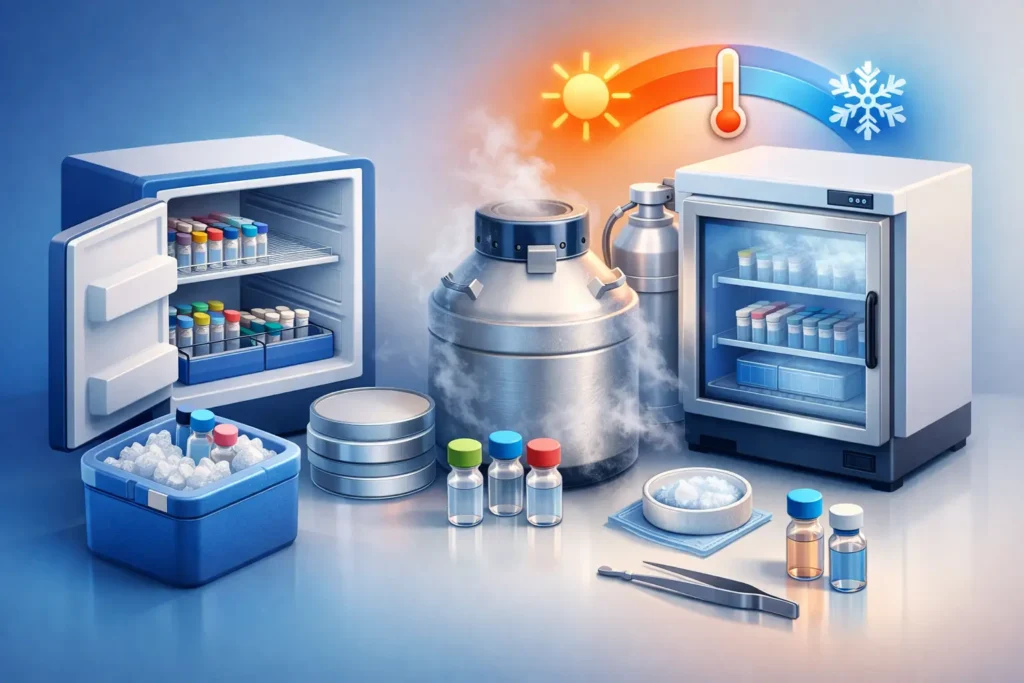
A research peptide storage temperature chart is useful only when it supports the product-specific handling instructions, certificate of analysis and experimental record. A single temperature rule cannot cover every peptide, format or study duration. Molecular sequence, formulation, vial headspace, moisture exposure, reconstitution solvent and the planned analytical workflow can all affect stability.
For controlled research use, the label and accompanying documentation always take priority. The chart below provides a practical framework for receiving, storing and documenting research materials while reducing avoidable temperature and handling variation. All materials supplied for this purpose are intended strictly for laboratory, analytical and experimental research use only, and are not for human or animal consumption.
Research peptide storage temperature chart
| Material state or activity | Typical controlled condition | Operational focus | |—|—:|—| | Lyophilised peptide, long-term storage | -20°C or colder, where product documentation permits | Keep sealed, dry and protected from light; minimise vial opening | | Lyophilised peptide, short-term working storage | 2-8°C only where stated by product guidance | Use for planned near-term work; avoid repeated moves between fridge and freezer | | Reconstituted peptide aliquots | Usually -20°C or colder, subject to product-specific guidance | Aliquot before freezing to avoid repeated freeze-thaw cycles | | Reconstituted material in active use | 2-8°C for the documented short-use period only | Record preparation time, solvent, concentration and discard date | | Ambient handling during preparation | Room temperature only for the shortest practical period | Protect from direct light, heat sources and unnecessary bench exposure | | Materials in transit on receipt | Assess immediately against the product instructions | Inspect packaging, record condition and transfer to storage without delay |
The temperatures in this chart are operational reference points, not universal stability claims. If a product label, batch document or supplier instruction specifies a different condition, follow that instruction. For unusual formats, including research tablets, capsules, amino blends or non-lyophilised preparations, the stated storage requirements may differ materially from those for a freeze-dried peptide vial.
Why temperature control affects research outcomes
Peptides are not interchangeable laboratory reagents. Their susceptibility to degradation varies with amino-acid sequence, concentration, pH, oxygen exposure and the presence of water. Heat can accelerate degradation pathways. Moisture can be particularly problematic for lyophilised material once a vial has been opened. Light may also affect compounds with light-sensitive residues or formulations.
The practical consequence is not simply a shorter shelf life. Uncontrolled storage can introduce a variable that is difficult to detect after the fact. A sample may still appear visually unchanged while its identity, purity profile or effective concentration has shifted. That creates avoidable uncertainty in analytical results and makes comparison between runs less reliable.
For laboratories working across several batches or projects, storage discipline is therefore part of method control. Independent third-party analytical testing and certificates of analysis establish the verified starting point. Correct receipt, storage and handling help preserve that starting point until the material enters the experiment.
The risk of repeated freeze-thaw cycles
Repeated freeze-thaw cycling is one of the most common preventable handling errors after reconstitution. Each cycle introduces another period of temperature change, possible condensation and handling exposure. The impact depends on the compound and formulation, but there is rarely an operational advantage in thawing an entire vial when only a small amount is needed.
Aliquoting a freshly prepared solution into appropriately labelled, low-dead-volume containers is often the more controlled approach. The aliquot volume should match expected use in a single run or a clearly defined short sequence of work. This reduces repeated access to the master preparation and improves traceability if a result needs to be reviewed later.
Do not assume that freezing always solves every stability issue. The chosen solvent, target concentration and container compatibility still matter. Record these variables in the study file rather than relying on memory or a generic laboratory convention.
Storage begins when the delivery arrives
Temperature control starts at goods-in, not when the vial reaches a freezer. On receipt, check the outer packaging, confirm the product and batch details, and compare the contents against the order and associated documentation. If the shipment includes a temperature-sensitive material, prioritise transfer to its designated storage condition.
A delayed unboxing on a busy bench can turn a well-controlled delivery into an undocumented exposure event. This does not automatically mean the material is unsuitable, but it does mean the laboratory has less information about its handling history. Serious research workflows should record any observed issue, including damaged packaging, unexpected warmth, condensation, a compromised vial or an extended delay before transfer.
Tracked delivery and controlled packaging support reliable receipt, but they do not replace a laboratory’s own acceptance procedure. Assign responsibility for receiving temperature-sensitive materials, particularly where deliveries may arrive outside core experimental hours.
How to manage lyophilised peptide vials
Lyophilised material is commonly selected because it can offer practical storage and transport advantages. Yet the dry appearance of a vial can lead to overconfidence. The key objective is to preserve the dry, sealed environment for as long as possible.
Store unopened vials in accordance with the product guidance, preferably in a clearly identified secondary container that protects against light, handling damage and accidental mix-ups. Keep desiccant arrangements intact where supplied. Do not leave vials on a bench while deciding how to organise stock.
When removing a vial from frozen storage, allow it to equilibrate to room temperature before opening if your documented procedure requires it. This helps reduce the risk of moisture condensing inside a cold vial. Once opened, work efficiently, reseal where appropriate and return any remaining material to its validated storage condition without unnecessary delay.
A useful stock label identifies the product, batch or lot, quantity, receipt date, storage location and status. A separate record should capture opening date and any reconstitution event. These details are mundane until a study needs troubleshooting, when they become highly valuable.
Reconstitution requires its own control plan
Reconstitution changes the risk profile. A dry peptide and a prepared solution should not be managed as though they have the same stability window. The solvent used, concentration achieved, mixing method and container type may all influence the solution’s suitability for the intended research method.
Use a solvent that is appropriate for the specific experimental protocol and material documentation. Maintain aseptic laboratory practice where required by the study, and avoid introducing unverified assumptions from unrelated compounds. If a solution must be stored, aliquot it promptly and document the number of freeze-thaw events permitted by the applicable procedure.
For an active working solution held at 2-8°C, define a short-use period before the experiment begins. The period should be based on available product information, method validation or internal stability evidence, rather than convenience. If no such evidence exists, treat the solution conservatively and prepare only the amount needed for the planned work.
Protect samples from light and mix-ups
Temperature is only one control. Clear or lightly coloured solutions can be exposed to light for hours in a refrigerator with a glass door or on an open bench. Use appropriate light protection where the product documentation or protocol indicates sensitivity.
Equally, label integrity matters. Every prepared container should state the compound identifier, concentration, solvent, preparation date, preparer initials and storage condition. Where several related peptide candidates are in use, use a second identifier such as a batch number or internal sample code. A correctly stored but incorrectly identified sample remains unusable research material.
Build the chart into a repeatable workflow
The most useful chart is one that appears in the laboratory’s normal workflow rather than as a poster no one consults. Add product-specific requirements to your inventory record at the point of receipt. Assign each item a storage location and ensure that the location is monitored, access-controlled where appropriate and not routinely overloaded with unrelated material.
Temperature logs should be reviewed, not merely collected. A freezer alarm, power interruption or door-left-ajar event needs an assessment against the known exposure period and the applicable product guidance. Document the decision to retain, quarantine or remove a material from use. This preserves the chain of reasoning behind the sample status.
It also helps to separate stock from working material. A master vial or unopened stock unit should not become the default source for repeated daily use. Designating working aliquots reduces handling of primary stock and gives researchers a clearer view of what remains available in verified condition.
When the chart should not be used alone
A generic chart is insufficient when a product has explicit storage instructions, when a study depends on tightly validated concentrations, or when material has experienced a known temperature excursion. It is also insufficient for interpreting purity or identity. Storage records can support an investigation, but they cannot substitute for appropriate analytical verification.
Where material condition is uncertain, quarantine it from active work pending review against the certificate of analysis, product documentation and internal quality procedure. Do not attempt to infer suitability from appearance alone. Transparent documentation is the more defensible route for laboratories that value reproducibility.
Careful storage is not a secondary administrative task. It is a practical extension of verified purity, identity and controlled handling – the conditions that allow research teams to place greater confidence in every subsequent measurement.