
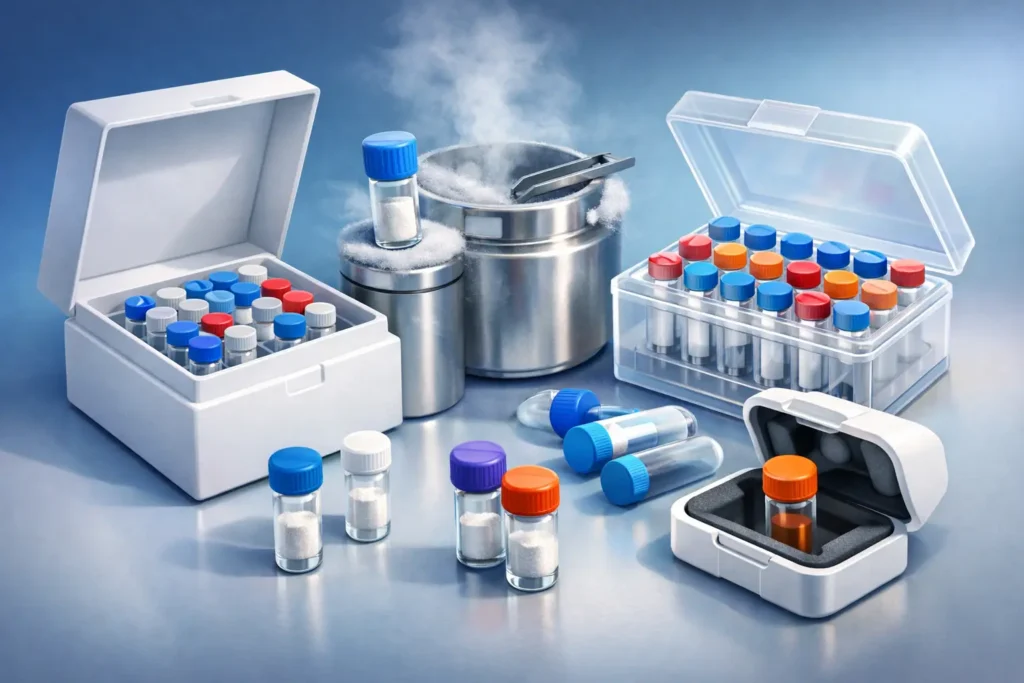
A peptide can test perfectly on receipt and still become a problem later because it was transferred into the wrong container, labelled poorly, or exposed to avoidable moisture and temperature fluctuation. Choosing the best peptide storage containers is not a minor housekeeping detail. For serious research workflows, it affects stability, traceability, contamination risk and whether a sample remains fit for analytical or experimental use.
For research buyers working to controlled handling standards, container choice should be treated as part of the storage protocol, not an afterthought. The right option depends on the peptide format, anticipated storage duration, the number of future retrievals and the level of documentation your laboratory requires. Research use only materials should always be stored, handled and recorded within clearly defined laboratory procedures.
What makes a peptide storage container suitable?
The best container is not simply the smallest vessel with a lid. It needs to protect sample integrity while supporting reproducibility. In practical terms, that means low interaction with the material, dependable closure performance, clear identification and compatibility with the intended storage temperature.
For many research settings, borosilicate glass vials remain the default standard because they offer excellent chemical resistance and low permeability. They are especially useful where long-term storage, freeze-thaw control or solvent compatibility matters. Amber glass adds light protection, which can be relevant for light-sensitive compounds or when exposure during bench handling is likely.
That said, glass is not automatically best in every case. It is breakable, heavier to handle, and not always ideal for repeated aliquot access in busy environments. High-quality laboratory-grade polypropylene tubes can be appropriate for short-term storage, aliquoting and workflows where reducing breakage risk matters. The trade-off is that plastics vary more in quality, can be more permeable over time, and may not offer the same confidence for extended storage of sensitive materials.
Best peptide storage containers by use case
Glass vials for long-term stability
If your aim is long-term storage under controlled laboratory conditions, glass vials with secure closures are usually the strongest choice. They provide a stable barrier against external conditions and support a cleaner chain of custody for valuable research compounds. A properly sealed glass vial is often the better fit where the sample may remain untouched for extended periods before analysis.
Crimp-top and screw-top formats both have their place. Screw-top vials are convenient and practical for many laboratories, particularly when access is occasional and staff need straightforward handling. Crimp-top systems can offer excellent seal consistency, but they require the correct equipment and introduce another handling step. If the lab does not already use validated crimping procedures, a poor crimp can create more risk rather than less.
Polypropylene tubes for aliquots and routine handling
When the key priority is repeated access without repeatedly opening a primary container, polypropylene aliquot tubes are often the more efficient option. Aliquoting allows the master sample to remain protected while small working volumes are retrieved as needed. That approach reduces repeated temperature cycling and lowers the chance of contamination entering the main batch.
Not all plastic tubes are equal. For peptide work, laboratory-grade tubes with tight manufacturing tolerances and reliable caps are worth the extra cost. Cheap general-purpose tubes can introduce uncertainty through weak seals, brittle plastic at low temperatures or inconsistent dimensions. In a controlled research environment, avoid treating secondary storage as a place to save pennies.
Amber containers for light-sensitive materials
Where a peptide or adjacent research compound is known or suspected to be light-sensitive, amber glass or appropriately rated light-protective containers are sensible. This is less about dramatic bench-top degradation in minutes and more about cumulative exposure across routine handling events. If a sample is moved, checked, relabelled and reopened multiple times, those exposures add up.
Amber storage should still be paired with disciplined handling. A dark container does not compensate for leaving materials out unnecessarily, storing them near heat sources or repeatedly opening them in humid conditions.
The closure matters as much as the container
A storage vessel is only as good as its seal. In peptide handling, closure integrity affects moisture ingress, contamination risk and storage consistency. For lyophilised materials, that point is especially important because even a technically suitable vial becomes a weak choice if the closure allows environmental exposure.
Look for caps or stoppers designed for laboratory use rather than generic packaging. The seal should remain dependable at the intended storage temperature, whether refrigerated, frozen or kept at another controlled condition specified for the material. If the closure liner is incompatible, poorly fitted or degraded by repeated use, the container stops being a protective system and becomes a source of variation.
This is one reason many laboratories keep primary storage and working storage separate. The primary vial stays sealed as much as possible. Working aliquots handle the day-to-day access.
Best peptide storage containers also support documentation
For professional research use, the best peptide storage containers are easy to label clearly and hard to misidentify. A high-quality sample in an anonymous tube is a preventable failure. Container choice should support legible labelling, batch traceability and storage logs that match the wider documentation set, including certificates of analysis where supplied.
Very small tubes can save freezer space, but they may create problems if labels become cramped, detached or unreadable after cold storage. It is often better to use a slightly larger format that accommodates a durable label and barcode than to force a sample into the smallest available option. Space efficiency matters, but not more than chain-of-identity control.
The same principle applies to external packaging. Secondary containment, rack mapping and location records are part of storage quality. If retrieving one sample means handling six others first, the workflow is already introducing unnecessary temperature and handling variation.
Choosing between single-container storage and aliquots
This is where the answer depends on the actual workflow. If a peptide will be used once for a defined analysis, a single well-sealed primary container may be entirely appropriate. If the material will be accessed repeatedly over weeks or months, aliquoting is usually the more controlled approach.
Aliquots reduce repeated freeze-thaw exposure and preserve the master sample, but they create more preparation steps at the outset. That means more handling, more labelling and more opportunities for operator error if the process is rushed. Laboratories with disciplined SOPs usually benefit from aliquoting. Less structured environments sometimes create confusion by overcomplicating a simple storage plan.
The best practice is the one your team can execute consistently. Precision without repeatability is not precision.
Material compatibility and environmental control
Container selection should be aligned with the actual storage environment. A freezer-compatible tube that becomes brittle at lower temperatures, or a cap that warps after repeated cold handling, is not fit for purpose. Equally, a chemically resistant vial means little if the sample is exposed to condensation each time it is removed from cold storage.
Moisture control deserves particular attention. Containers should be opened only when necessary and under conditions that minimise environmental exposure. For hygroscopic materials or sensitive preparations, reducing open time can matter as much as the container material itself. In practice, the best peptide storage containers are part of a controlled handling system that includes temperature discipline, clear retrieval planning and limited access.
What to avoid
Avoid repurposed household containers, cosmetic jars, supplement pots and any vessel not designed for laboratory storage. They may seem convenient, but they offer poor assurance on material compatibility, seal performance and contamination control. For the same reason, avoid transferring samples unnecessarily just to standardise appearances across storage racks.
Also be cautious with very low-cost generic tubes bought without provenance. If a container has no clear specification for material, temperature tolerance or closure reliability, it introduces an avoidable unknown into the workflow. For research buyers who already insist on independent third-party analytical testing and verified identity, it makes little sense to become casual at the storage stage.
A practical standard for research buyers
For most qualified research settings, a sensible baseline is straightforward. Keep the original verified primary packaging where possible, especially when supplied under controlled handling standards. Use laboratory-grade glass vials for long-term retention and validated polypropylene aliquot tubes for working portions where repeated access is expected. Prioritise seal integrity, light protection where relevant, and labelling that remains readable throughout storage.
If you source from a supplier such as Precision Peptides, the same compliance mindset used for product verification should carry through to storage after receipt. Third-party testing, purity verification and certificates of analysis help at the purchasing stage. Appropriate containers, controlled handling and documented storage are what protect that value once the material reaches your lab.
A reliable container does not make weak handling acceptable, but it does remove one common source of avoidable error. When the objective is consistent research output, that is exactly the kind of variable worth controlling.