
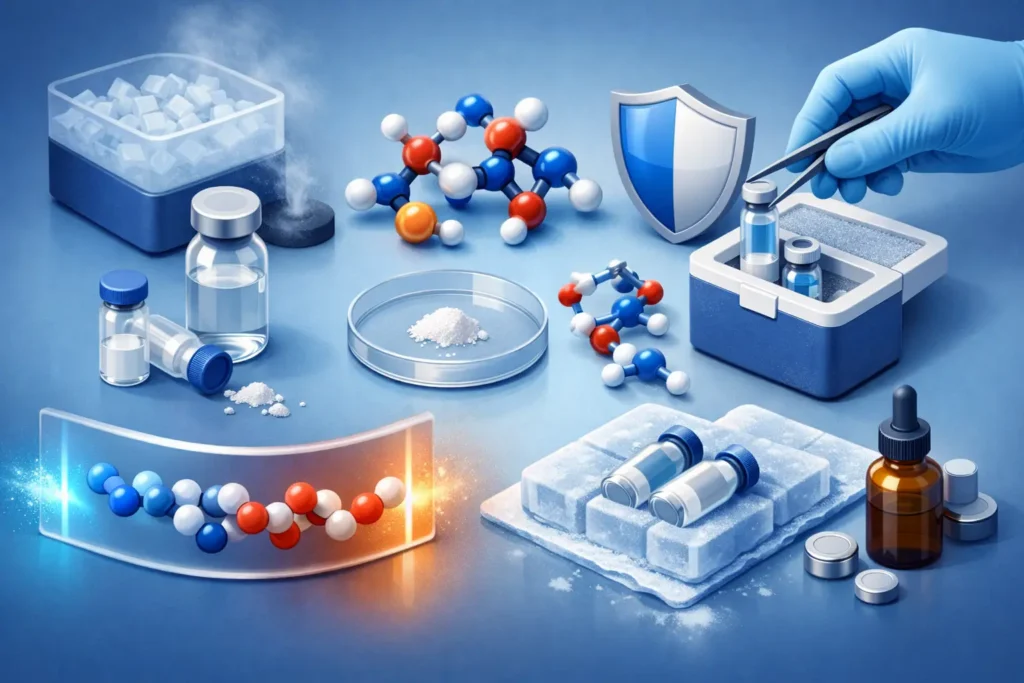
A peptide can leave the supplier in verified condition and still lose integrity within minutes of poor bench practice. If you need to know how to prevent peptide degradation during handling, the answer is rarely one dramatic failure. More often, it is cumulative exposure to heat, moisture, repeated freeze-thaw cycles, unsuitable solvents, surface adsorption, or avoidable delays between receipt and controlled storage. For research use only, and not for human or animal consumption, peptides should always be handled within a documented laboratory process that protects identity, purity and reproducibility.
Why peptide degradation happens so easily
Peptides are chemically useful precisely because they are chemically active. That also makes them vulnerable. Depending on sequence, chain length and formulation, a peptide may be susceptible to hydrolysis, oxidation, deamidation, aggregation or adsorption to container surfaces. Some sequences tolerate routine manipulation reasonably well. Others degrade quickly if reconstituted in the wrong medium or left too long at ambient temperature.
The practical point is that peptide stability is sequence-dependent. There is no single rule that covers every vial. Methionine, cysteine, tryptophan and histidine residues can raise oxidation risk. Asparagine and glutamine may be more prone to deamidation under certain conditions. Hygroscopic materials can take up moisture during routine opening and closing. That is why handling controls matter as much as starting purity.
A certificate of analysis confirms what was verified at release. It does not replace controlled storage, disciplined reconstitution practice or traceable in-lab handling after delivery.
How to prevent peptide degradation during handling at receipt
Handling starts when the shipment arrives, not when the vial is opened. Inspect the package promptly, confirm the product identity against your order and documentation, and move the material into the appropriate storage condition without unnecessary delay. If a peptide is intended for frozen storage, time on the bench should be kept to a minimum while receipt checks are completed.
It is good practice to log arrival date, batch details and storage location immediately. For research teams running multiple compounds at once, this reduces the very common problem of a vial being left in secondary packaging while other tasks take priority. A measured, traceable intake process does more to protect material quality than most people admit.
If condensation is likely after cold transit, allow sealed containers to equilibrate appropriately before opening where your SOP requires it. Opening a cold vial too soon can introduce moisture directly into the material, particularly with lyophilised peptides. That is a preventable source of instability.
Temperature control matters more than most handling errors admit
Temperature is one of the fastest ways to shorten peptide viability. Even when visible change is absent, cumulative thermal exposure can accelerate chemical breakdown. Lyophilised peptides are generally more stable than reconstituted solutions, but neither should be treated casually.
Short bench exposure during transfer may be unavoidable. Extended room-temperature holding should not be routine. Plan the task before removing the vial from storage. Have the solvent, pipettes, labels and aliquot containers ready first. The less time a peptide spends waiting for the operator, the better the outcome tends to be.
Repeated movement between freezer and bench is another common weakness. If a peptide will be used over several sessions, aliquoting is usually preferable to thawing and refreezing the full volume each time. There is a trade-off here. More aliquots mean more primary handling events and more container surfaces. Fewer aliquots mean more freeze-thaw stress. The right balance depends on study design, expected use frequency and the known stability of the specific peptide.
Moisture and air exposure are frequent causes of avoidable loss
Lyophilised peptides should be protected from ambient humidity. Once a vial is opened, every unnecessary minute increases exposure to moisture and oxygen. In practical terms, that means working efficiently, recapping promptly and avoiding repeated opening of the same vial where aliquoting could remove that risk.
Air exposure is especially relevant for oxidation-sensitive sequences. If your laboratory uses inert gas procedures for susceptible materials, they should be applied consistently rather than selectively. Even without advanced controls, limiting headspace exposure and shortening open-vial time can reduce avoidable deterioration.
Do not assume that a tightly closed cap reverses prior moisture uptake. Once water has been introduced, hydrolytic processes may already be under way. Prevention is more reliable than trying to rescue compromised material later.
Reconstitution is where many stability problems begin
Poor reconstitution decisions are a leading cause of peptide loss. Solvent choice, pH, ionic strength and final concentration all influence stability. Some peptides dissolve readily in sterile water-based systems. Others require a staged approach, such as initial dissolution in a small volume of a compatible solvent before dilution. The wrong approach can cause precipitation, aggregation or accelerated degradation.
This is why sequence-specific guidance matters. Follow the product documentation and laboratory protocol rather than relying on a one-size-fits-all method. If bacteriostatic water or another research-grade diluent is being used, confirm suitability for the peptide and the intended analytical workflow before use. Convenience should not decide the solvent.
Overly dilute solutions can also create problems. At low concentrations, adsorption to glass or plastic surfaces may become more significant relative to the total mass in solution. Very high concentrations, on the other hand, may increase aggregation risk for certain sequences. Stability sits within a usable range, not at a universal fixed point.
Light, pH and surface effects are often underestimated
Not every degradation pathway is obvious at first glance. Light exposure can affect photosensitive residues or formulations, especially during prolonged bench work near windows or under strong laboratory lighting. If the peptide is known or suspected to be light-sensitive, amber containers or reduced light exposure should be part of routine control.
pH is equally important. A peptide may appear fully dissolved while degrading faster in an unsuitable pH range. Extreme acidity or alkalinity can increase hydrolysis, alter side chains or affect assay behaviour later. Reconstitution should therefore be designed around both solubility and downstream stability, not solubility alone.
Surface adsorption is another quiet source of loss. Small working volumes are especially vulnerable. Peptides can bind to tubes, pipette tips and storage vessels, which distorts concentration and can create false assumptions about degradation. Low-binding consumables may be justified in sensitive workflows, particularly for low-concentration preparations or valuable reference material.
How to prevent peptide degradation during handling in day-to-day lab use
The most reliable laboratories reduce handling variability rather than trying to compensate for it afterwards. A controlled routine usually includes pre-labelled aliquots, defined thaw times, restricted room-temperature exposure, documented solvent systems and clear discard criteria for aged or repeatedly thawed material.
It also helps to assign accountability. If several operators access the same peptide stock, degradation risk rises when nobody owns the log. Record reconstitution date, solvent used, concentration, storage condition and number of freeze-thaw events. This is not paperwork for its own sake. It supports traceability when an assay shifts unexpectedly.
For higher-value compounds, consider preparing a master stock and separate working stocks. That keeps the primary material protected while allowing routine access to smaller volumes. It is a simple control, but often the difference between reproducible work and unexplained drift.
Supplier quality still matters after the vial arrives
Handling discipline cannot correct poor starting material. Serious research buyers should source peptides verified by independent third-party analytical testing, with certificates of analysis supporting identity and purity review before use. That documentation gives your laboratory a reliable starting point and reduces uncertainty when investigating performance issues.
Precision Peptides follows a quality-first model built around verified purity and identity, controlled packaging standards and transparent documentation for research workflows. That does not remove the need for correct in-lab handling, but it does mean the chain of control begins before delivery.
Fast, tracked shipping also has practical value. The less uncontrolled transit time a temperature-sensitive research material experiences, the less strain is placed on downstream storage decisions at receipt.
The handling standard that protects your data
If peptide performance matters to your work, handling should be treated as part of method control, not as a minor bench task. Start with verified material, move it quickly into appropriate storage, minimise moisture and air exposure, choose the reconstitution system with care, and avoid repeated freeze-thaw cycles wherever possible. Small lapses accumulate.
The useful mindset is simple: every transfer, every minute at ambient temperature and every undocumented deviation changes risk. The laboratories that preserve peptide quality best are usually not doing anything flashy. They are just precise, consistent and unwilling to improvise when the material is already vulnerable.