
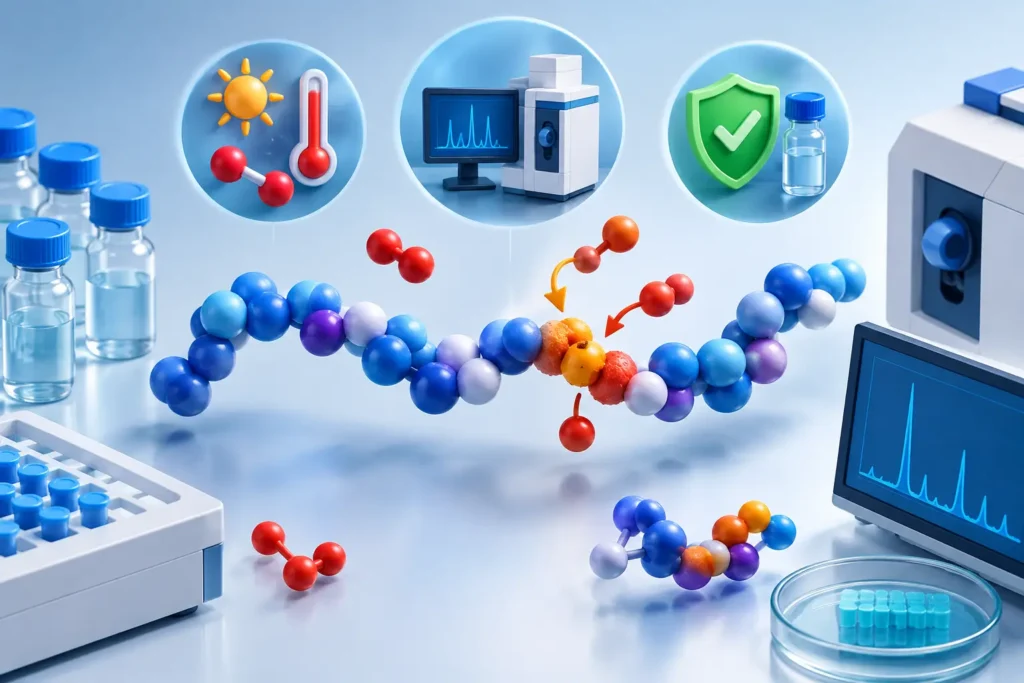
A peptide can meet its stated purity at release and still become a different analytical question after unsuitable storage or handling. Peptide oxidation is one of the most common chemical pathways behind unexpected secondary peaks, mass shifts and inconsistent experimental results. For laboratories working with measured quantities of high-purity research materials, controlling that pathway is part of protecting the integrity of the study.
Oxidative change is not a cosmetic defect. Depending on the sequence, formulation and experimental conditions, it can alter molecular mass, chromatographic behaviour, conformation, solubility and target interaction. A vial that appears unchanged may therefore no longer perform as the material documented on its certificate of analysis.
All peptide products discussed here are strictly for laboratory, analytical and experimental research use only. They are not for human or animal consumption.
What peptide oxidation is
Peptide oxidation is a chemical modification caused when susceptible residues react with oxidising species. Molecular oxygen can contribute, but it is rarely the only factor. Light exposure, elevated temperature, trace metal ions, peroxide contaminants, repeated solution handling and unsuitable buffer conditions can all increase the rate of oxidation.
Methionine is particularly well known for oxidising to methionine sulfoxide, typically producing a mass increase of 16 Da. Tryptophan, cysteine, tyrosine and histidine may also be affected, although the resulting products and analytical signatures vary. Cysteine requires particular attention because oxidation can form disulphide-linked species or more extensively oxidised products depending on conditions.
The practical point is that susceptibility belongs to the whole system, not simply the peptide sequence. A peptide containing methionine may remain stable under one set of controlled conditions and degrade rapidly under another. The relevant variables include excipients, headspace gas, moisture content, container materials, reconstitution solvent, pH and the time the material spends in solution.
Why peptide oxidation matters to analytical work
An oxidised peptide is not automatically unusable. In some investigations, oxidation products are the subject of the work. In most routine assays, however, unplanned oxidation introduces a variable that can obscure interpretation.
A small oxidised fraction may broaden or split an HPLC peak, complicate purity calculations or affect quantification. For binding, enzymatic or cell-based experiments, the consequences can be more pronounced because a modification at a critical residue may alter structure or functional activity. Whether the impact is negligible or material depends on the peptide, the assay and the acceptance criteria established by the laboratory.
This is why a certificate of analysis should be treated as release documentation, not as proof of condition after delivery, storage and use. Independent third-party analytical testing, verified purity and identity, and clear batch documentation establish a controlled starting point. Good laboratory practice then preserves that starting point through the experimental lifecycle.
The main drivers of peptide oxidation
Oxidation often reflects several manageable stresses acting together. The following factors deserve attention during receipt, storage, reconstitution and analysis:
- Temperature: Higher temperatures accelerate many degradation reactions. Avoid unnecessary exposure during bench work, shipment receipt and transfer between storage locations.
- Light: UV and strong ambient light can promote photo-oxidation, especially where photosensitive residues or impurities are present.
- Moisture: Lyophilised material is generally more stable when kept dry. Moisture can increase molecular mobility and create conditions that favour degradation.
- Oxygen and headspace: Repeatedly opening a vial introduces fresh air and can be significant for small quantities used across multiple sessions.
- Trace metals and contaminants: Metal ions, residual peroxides in solvents or plasticware, and contaminated buffers can catalyse oxidation.
- Solution conditions: pH, solvent composition, concentration and time in solution all influence stability. A reconstitution method that is appropriate for one sequence may be unsuitable for another.
The trade-off is straightforward: convenience can increase risk. Keeping a working solution ready for repeated use may save preparation time, but it can also create a longer window for oxidative change than storing appropriately aliquoted dry material or freshly prepared solutions.
Detecting peptide oxidation with confidence
Visual inspection has limited value. Changes may be invisible, while colour changes or particulates can have causes unrelated to oxidation. Analytical confirmation is required when the result matters.
LC-MS and mass shifts
Liquid chromatography coupled with mass spectrometry is frequently the most direct route to identify likely oxidation products. A +16 Da mass shift is consistent with a single oxygen addition, while +32 Da can indicate two such modifications. These shifts are useful indicators, not final proof of residue location. Fragmentation data may be required to determine the modified site, particularly for sequences with more than one susceptible residue.
Chromatographic separation also matters. Oxidised and unoxidised forms may elute separately, allowing relative peak-area monitoring under a validated or fit-for-purpose method. Co-elution, ionisation differences and method conditions can complicate interpretation, so results should be assessed in the context of the method rather than treated as a single universal threshold.
HPLC purity profiling
Routine HPLC can provide a practical trend check where an established reference profile is available. New or growing peaks, altered retention times and reduced main-peak area may indicate degradation. It cannot always identify the chemical cause on its own, but it is valuable for comparing a retained reference sample, a freshly reconstituted aliquot and a sample exposed to a suspected stress.
Control samples and documentation
A meaningful investigation needs controls. Retain the batch number, certificate of analysis, receipt date, storage conditions, reconstitution details, solvent and buffer lot numbers, and the number of freeze-thaw or vial-opening events. A freshly prepared comparator is often more informative than repeating an assay with the same aged solution.
Where a laboratory observes an unexpected result, record the observation before changing several variables at once. Re-test against a controlled reference, then isolate likely contributors such as light exposure, buffer age or handling duration. This produces defensible data rather than a guess about the source of variation.
How to control peptide oxidation in routine workflows
The most effective controls are usually operational rather than dramatic. Begin by following the specific storage and handling information supplied for the product and retain its documentation with the study record. If the laboratory requires a different condition for a particular method, evaluate it as a method-specific decision rather than assuming it will preserve every peptide equally well.
For lyophilised research peptides, minimise exposure to warmth and humidity during handling. Allow sealed containers to equilibrate appropriately before opening where condensation is a risk. Work efficiently, close containers promptly and avoid leaving vials uncapped on the bench. If repeated use is expected, aliquoting under controlled conditions can reduce repeated exposure of the full quantity.
After reconstitution, use clean, compatible laboratory-grade solvents and containers. Prepare only the volume required where feasible, label it clearly and establish a defined hold time. The right hold time cannot be inferred from the peptide name alone. It should reflect available stability data, the assay requirements and the laboratory’s own verification work.
Avoid assuming that freezing resolves every problem. Freezing may slow degradation, but repeated freeze-thaw cycles, variable freezer performance and unsuitable solution composition can still affect sample quality. For some workflows, single-use aliquots offer better reproducibility than repeatedly thawing one stock solution.
Light-sensitive materials should be protected throughout preparation and storage, not only during long-term retention. Similarly, do not overlook the quality of supporting reagents. A verified peptide can still produce misleading results if an aged buffer, contaminated solvent or poorly maintained piece of equipment introduces oxidative stress.
Purchasing and receiving research peptides with oxidation in mind
Supplier controls establish the baseline for the work that follows. Researchers should look for clearly defined identity and purity verification, batch-specific certificates of analysis, controlled packaging and transparent handling information. Independent third-party analytical testing provides an additional level of confidence that the supplied material matches its documented specification at release.
On receipt, inspect packaging, confirm the product and batch against the order record, and transfer the material to the recommended controlled storage environment without delay. If shipping conditions, package integrity or labelling raise a concern, quarantine the material and document the issue before use. Fast, tracked and discreet delivery supports operational planning, but laboratory receipt procedures remain essential.
Precision Peptides supplies high-purity materials for controlled research use, supported by purity and identity documentation. As with any research reagent, the certificate of analysis, storage record and analytical result should be considered together when establishing fitness for a specific experimental purpose.
When an oxidised peak appears
Do not assume a new peak means the original product was unsuitable. First review the timeline: was the change present in the initial release documentation, observed on receipt, or introduced after reconstitution and handling? Compare retained material where available, review solution preparation records and use LC-MS to investigate plausible modifications.
The appropriate response depends on the study. A minor, characterised oxidative species may fall within an assay’s predefined tolerance. In a sensitive mechanistic or quantitative method, the same observation may require fresh material, a revised preparation process or formal method reassessment. The decision should follow the experiment’s acceptance criteria, not convenience.
Careful control of peptide oxidation is ultimately a discipline of traceability. Preserve the verified material you purchased, record the conditions you create, and let the analytical evidence determine whether a sample remains suitable for its intended research use.