
A reconstitution solvent is not a minor purchasing decision when the work depends on repeatable measurements. The choice can affect sample stability, microbial-control strategy, assay compatibility and the quality of the resulting records. Knowing when to use bacteriostatic water begins with the protocol, the material under investigation and whether repeated withdrawals are genuinely required.
Bacteriostatic water is a research supply, not a universal diluent. For laboratory, analytical and experimental research use only, it must never be treated as suitable for human or animal consumption, administration or therapeutic use. The manufacturer’s product label, the relevant study protocol and institutional procedures should always determine the final choice.
What bacteriostatic water is designed to do
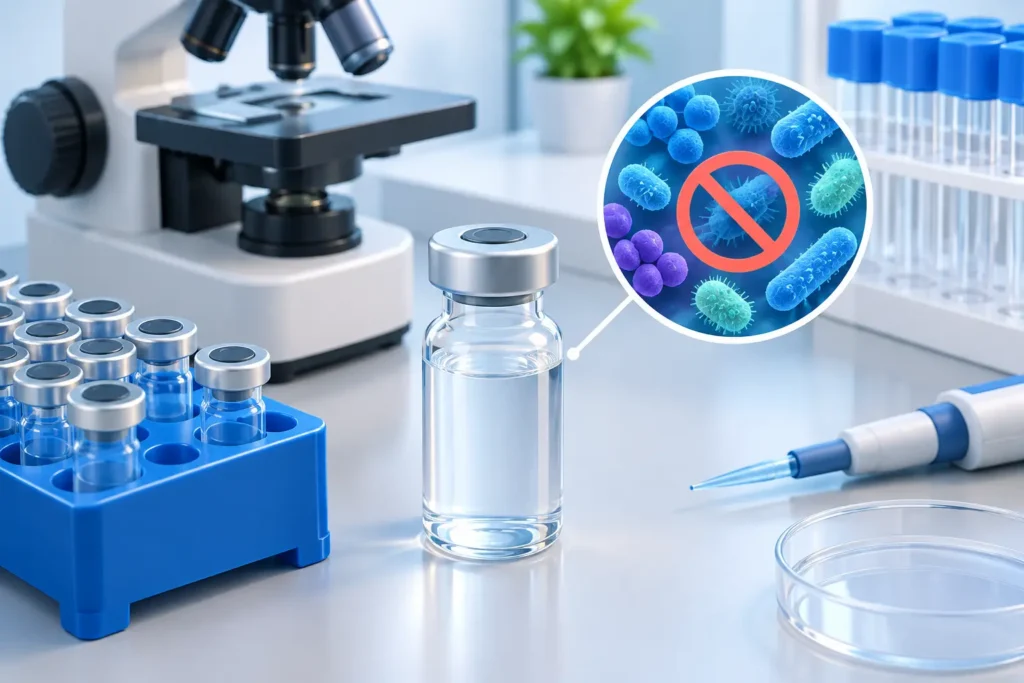
Bacteriostatic water is sterile water formulated with a bacteriostatic preservative, commonly benzyl alcohol at a stated concentration. The preservative is intended to inhibit the growth of bacteria introduced during repeated vial access. It does not make an already contaminated solution sterile, remove endotoxins, correct poor technique or preserve the integrity of a research compound.
That distinction matters. A vial can remain visually clear while its contents have changed in ways that are not visible. Researchers should therefore treat bacteriostatic water as one controlled component of a validated workflow, rather than as a safeguard against inadequate handling.
The exact formulation matters as well. Do not assume that every product sold under a similar description contains the same preservative concentration or is appropriate for the same analytical context. Verify the label, batch information and supporting documentation before use. Where documentation is required for a research record, retain the lot details for both the water and the material being reconstituted.
When to use bacteriostatic water
Bacteriostatic water is most often considered where a controlled research protocol calls for a sterile aqueous diluent with antimicrobial preservation and the resulting solution may need to be accessed more than once. This can be relevant to an experiment involving aliquoted preparation, repeated analytical sampling or staged evaluation of a compatible research material.
Compatibility is the deciding factor. The preservative may interact with some compounds, interfere with a readout or alter the behaviour of a preparation. A protocol that requires preservative-free water, a defined buffer, saline, an organic solvent or another vehicle should be followed exactly. Substituting bacteriostatic water simply because it is available can compromise comparability between runs.
Use may be appropriate only after confirming three points: the research material is compatible with the formulation, the planned method permits the preservative, and the handling plan requires repeat access rather than a single preparation. If any of those points is unclear, the correct response is to pause and verify the source protocol or conduct appropriately controlled compatibility work.
Repeated access is not the only consideration
The potential benefit of bacteriostatic water is greatest when the workflow has been designed for repeated withdrawals under controlled conditions. That does not mean every multi-step project requires it. Many laboratories instead prepare small single-use aliquots from a preservative-free solution to minimise variables and reduce repeated access to a primary vial.
For sensitive work, fewer variables can be preferable. A preservative may be chemically insignificant in one method but create background signal, affect binding behaviour or complicate interpretation in another. The right choice is the one that protects the validity of the experiment, not necessarily the one that appears most convenient.
When sterile water or another diluent may be better
Sterile water without a bacteriostatic preservative may be the better fit when a method specifies preservative-free conditions, when the solution will be prepared and used as a single-use sample, or when benzyl alcohol could influence the research objective. The same applies when an assay has low tolerance for additional excipients or when a reference method identifies a different solvent or buffer.
Some materials require more than water. pH, ionic strength, solubility and storage stability can all influence whether a compound remains suitable for analysis after reconstitution. A material may dissolve in water yet still be unsuitable for the intended study because it degrades, aggregates or produces inconsistent results over time.
Do not use bacteriostatic water as a substitute for a protocol-defined buffer. Its preservation properties do not provide pH control, isotonicity, stabilisation or broad compatibility. Equally, do not select it to extend a preparation beyond the stability period established by the method or the material supplier. Microbial inhibition and chemical stability are separate questions.
Handling controls that protect research quality
Once the appropriate diluent has been selected, controlled handling determines whether it remains fit for purpose. Work in a clean, suitable research environment and follow local laboratory procedures for aseptic technique, equipment qualification and record keeping. Inspect the container before use. Do not proceed if the seal is compromised, the liquid appears discoloured or particulate matter is present, or the label and lot information cannot be verified.
Use clean, compatible equipment and avoid unnecessary repeated entries into the vial. Each access creates an opportunity for contamination or handling variation. If a study requires multiple timepoints, an aliquoting plan can reduce avoidable risk and make the sample trail easier to document.
Accurate calculation is equally central. Confirm the required concentration, final volume, units and the amount of research material before preparation. Record the lot numbers, preparation date, diluent used, target concentration, storage condition and any observed changes. These details make a failed or unexpected result easier to investigate and support reproducibility across researchers and study runs.
Storage should follow the product label and the requirements of the reconstituted research material. Those requirements may not be identical. A correctly stored diluent cannot compensate for a peptide or compound that requires different temperature, light protection or use conditions after preparation. Where there is uncertainty, use the more conservative validated requirement rather than relying on assumption.
Documentation is part of the decision
For serious research buyers, choosing bacteriostatic water should sit within the same verification process used for the primary material. Confirm identity, stated composition, batch traceability and supplier documentation. Independent third-party analytical testing and certificates of analysis are valuable for establishing confidence in supplied research compounds, but they do not replace method-specific compatibility assessment after reconstitution.
A supplier can verify purity and identity of a material, while only the researcher’s controlled protocol can establish whether a particular diluent is appropriate for a particular assay. Maintaining that distinction prevents an avoidable gap between purchasing documentation and experimental validity.
Precision Peptides supplies research materials and supporting compounds for laboratory, analytical and experimental use only. Buyers should review the relevant product information and ensure all handling, storage and disposal decisions align with their own research controls, applicable procedures and lawful intended use.
Common mistakes to avoid
The most frequent error is treating bacteriostatic water as interchangeable with sterile water. It is not. The preservative changes the formulation, and that change may matter to the material or the analytical method.
Another error is assuming bacteriostatic means contamination-proof. It does not. Poor aseptic practice, unsuitable equipment, damaged closures and excessive repeated access can still undermine a preparation. A third is overlooking time: a preservative does not establish the stability of a reconstituted sample or authorise use beyond the protocol’s validated window.
Finally, avoid making decisions from appearance alone. Clarity is useful as a basic inspection point, but it cannot confirm concentration, purity, sterility after handling or retained activity. Verification comes from documented process control and, where appropriate, analytical assessment.
The practical question is not whether bacteriostatic water is generally useful. It is whether its defined formulation supports the specific research method without adding an uncontrolled variable. When that answer is supported by protocol, compatibility evidence and disciplined handling, the diluent becomes a reliable part of the experiment rather than a source of uncertainty.